
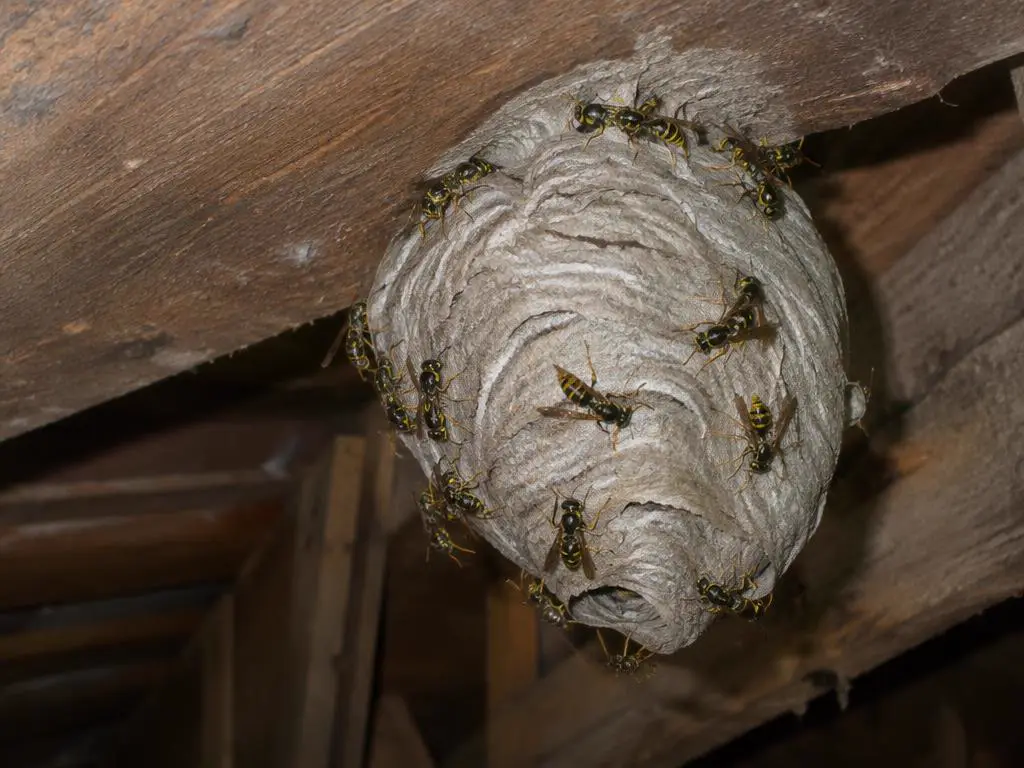
The autumn nest problem
If you are finding slow, drowsy wasps inside your house after mid October, they may be coming from a nest that is already at the end of its life. This is the autumn nest problem, and at this time of year we often advise against treating the nest. Treatment can drive more wasps into your rooms, and the problem can drag on for longer than if the nest is left to die naturally. Below we explain why, and what you can do instead.
Why wasps come indoors in late autumn
By mid October many wasp colonies are declining, although mild weather and sheltered conditions can keep some active for longer. New queens leave to find somewhere to overwinter, while the old queen and remaining workers eventually die. As the nights turn cold, workers can become slow, and indoor light may draw them towards occupied rooms.
If the nest is in your loft, a wall cavity or above a ceiling, the wasps can find their way into the house through an internal gap: around ceiling light fittings and downlights, the loft hatch, extractor fans, gaps around pipes, or cracks in old plaster. That is why people may find them in one bedroom or on one landing, usually near a window or light.
Slow wasps can still sting if trapped against skin, trodden on or caught in bedding. Do not assume that drowsiness or the time of year makes an insect safe to handle.
Why treating a late-season nest can make things worse
Our treatment works by placing insecticide dust at the nest entrance. When foraging wasps regularly fly through it, they carry it into the colony. Late in the season that traffic may have largely stopped, so there is less movement to carry the treatment where it needs to go.
That is why, when wasps are already getting into the house after mid October, we will usually give you honest advice over the phone rather than book a treatment.
- Agitated wasps may look for another way out. When a weakened colony is treated, surviving wasps can leave the nest — and if an accessible route is into your house rather than out through the roof, that is where they may go. More wasps can appear indoors for days afterwards, not fewer.
- It can prolong the indoor problem. Instead of activity tailing off quietly as temperatures drop, you may get a trickle of dying wasps indoors over a couple of weeks. That is an observed possibility, not a guaranteed duration for every house.
- You may be paying for something nature is about to do. The annual wasp colony comes to an end as the season progresses, and its old paper nest is not reused the following year.
- Treating does not stop queens overwintering elsewhere. New queens may already have left the colony and sheltered in a loft recess, curtains or a shed; nest treatment does not reach queens that have moved away.
When late-season treatment still makes sense
There are exceptions, and we will tell you if yours is one:
- The nest is still busy, with a steady stream of wasps flying in and out of an outside entrance, and no wasps getting indoors.
- The nest entrance is beside a door, path or play area that cannot be avoided, especially where someone in the household has a sting allergy.
- Commercial premises, schools or care homes where the risk needs managing.
- A large nest during a mild spell, when the colony is still very active.
What to do if wasps are getting into your house
- Note where wasps appear without approaching the suspected nest. An area near a ceiling light or loft hatch may be involved, but do not open a fitting, fan or building void to investigate.
- Keep the affected room separate where practical, and avoid unnecessary lighting there in the evening. Do not seal the nest entrance outside: that can divert wasps into other routes.
- Ask for advice before closing an internal gap. Do not tape over downlights, electrical fittings, extractor fans or designed ventilation; electrical or building repairs need an appropriate qualified tradesperson.
- Avoid catching, swatting or vacuuming wasps when doing so brings you close enough to be stung. Keep children and pets away, wear shoes in affected areas and check bedding, clothes and towels carefully before using them.
- Do not spray into the ceiling, light fittings or loft. Any household insecticide must be used only as its label permits, never into electrical equipment or as an improvised concealed-nest treatment.
- If someone has a known sting allergy, follow their clinician’s plan and keep prescribed adrenaline accessible. Call 999 for breathing difficulty, swelling of the mouth or throat, faintness or collapse after a sting; use a prescribed adrenaline auto-injector as directed.
What happens next
In many cases the wasps indoors tail off as the weather gets colder. The first overnight frost is often a useful sign that the season is ending, but it is not a guaranteed deadline: sheltered colonies may remain active afterwards. Judge inactivity from the situation and advice, not from a frost forecast alone.
The old nest is not reused. If it is in the loft you can normally leave it, or consider removal only once inactivity and safe access are established. Before next spring, discuss appropriate repairs to the internal gaps the wasps used, preserving ventilation and the safety of electrical fittings.
Not sure? Talk to us first
Every situation is a little different. Share a photo or short video taken safely from where you already stand, and a technician will tell you honestly whether treatment is likely to help or whether waiting with precautions is the better option.
Sources
Frequently asked questions
Why are there wasps in my bedroom after mid October?
A declining loft or wall colony is one possible source, especially if wasps repeatedly appear near an internal gap. The date alone cannot establish the cause; describe the pattern without opening the void.
Should I get a wasp nest treated after mid October?
Ask for advice first when wasps are already indoors. Treatment may increase indoor movement, but a busy colony causing an unavoidable sting risk can still need a visit.
Will the wasps come back to the same nest next year?
They do not reoccupy that old paper structure. Another queen can start a separate nest nearby, so suitable repairs should address access rather than depend on removing the old nest.
Are late-season wasps dangerous?
They can sting even when moving slowly. Keep bare feet, children and pets away from affected floors, and take particular care with bedding and clothing.