
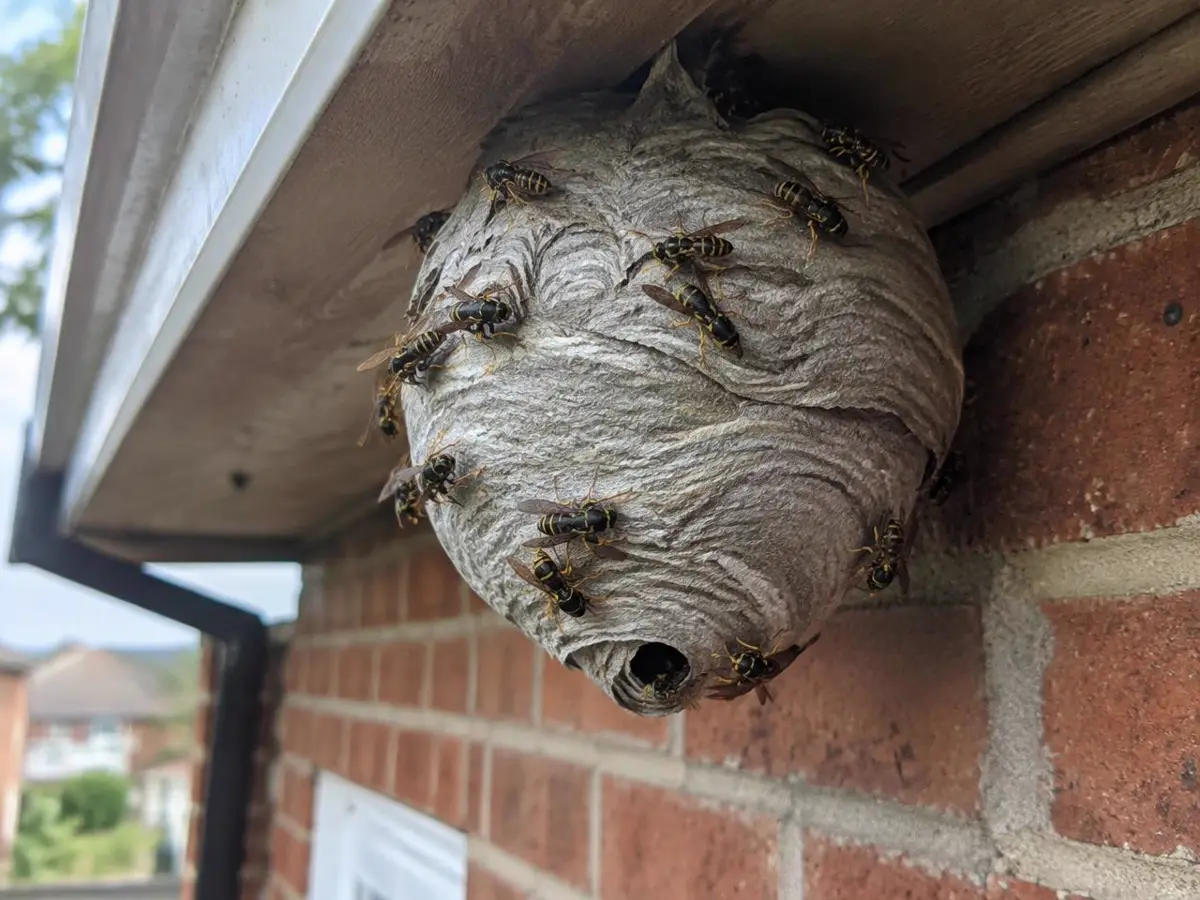
How much does wasp nest removal cost in Middlesex?
Our fixed price is £129 for a wasp or European hornet nest treatment, with no call-out fee and a free revisit if required. Treatment targets the active colony; removing an inaccessible paper nest or carrying out building repairs is not the same service. Describe the access and number of suspected nests before booking.
Our price: £129 fixed
Wasp nest treatment in Middlesex costs £129 with us. That is a fixed price for treating a wasp or European hornet nest, confirmed on the phone before we book. There is no call-out fee, nothing is added on the day and a revisit is free if the treated nest is still active after 48 hours.
The useful comparison is not simply a headline figure: it is whether the quote covers assessment, treatment of an active nest and advice afterwards. A nest hidden in a roof void is not the same job as collecting an old paper nest from an empty shed, so tell us what you have seen before booking.
What the £129 includes
The price covers the visit, identifying the entrance the colony is using, treating the nest from the ground with a telescopic pole, and after-care advice for that location. Hornet nests are included at the same price. If the nest is still active after 48 hours, the revisit costs nothing.
Treatment does not include building work. Opening a roof, soffit or wall is rarely needed, because the colony is treated through the entrance it already uses.
- Visit with no call-out fee
- Treatment of one wasp or hornet nest
- Hornets at the same price
- Free revisit if the nest stays active
- After-care advice
What could change the price
Most homes pay £129 and nothing else. The price is confirmed before booking where the job is different from a single domestic nest: commercial premises, and separate nests in different parts of the same property. Several entrances do not always mean several nests, so we agree the scope on the phone first and never add charges on the day.
How £129 compares with typical UK prices
Prices for wasp nest treatment around the UK vary widely. Some councils still offer a service, others have stopped, and private firms set their own rates. A low advertised figure can grow once a call-out charge, a second visit or a weekend surcharge is added. A single fixed price with no call-out fee and a free revisit lets you compare like with like.
When you compare quotes, ask whether the amount is the full price, whether a call-out charge applies and what happens if activity continues after treatment.
Treatment and physical removal are different
People often say “removal” when they mean getting rid of the wasps using a nest. Treatment targets the active colony. Physically taking out the paper structure is a separate matter and may be unnecessary, particularly when it is inside a wall or roof space that cannot be opened without building work.
An old wasp nest is not reused by another colony. That does not mean every nest found in a loft is inactive, or that the same roof cannot attract a queen to a different position next spring. Ask what will happen to the nest structure, rather than assuming removal of building materials is included in pest control.
Information to give when requesting a quote
Describe the entry point, the height as seen from the ground and whether wasps are coming into occupied rooms. Say if activity is at one opening or several. Several openings can serve one concealed space, while separate nests may also occur on the same property; an entry count is not a reliable nest count.
Mention access through side passages, locked gardens or communal areas. Tell us about anyone with a known sting allergy and whether children, pets or visitors use the route. A clear description helps us explain the likely approach without asking you to enter a loft, move stored items or disturb the nest to investigate.
Comparing wasp control quotes fairly
Ask whether the quoted amount is the full price, whether a call-out charge applies and what happens if activity continues after treatment. With our service, the fixed price is agreed on the phone, there is no call-out fee and a revisit is free. Raise uncertainty before confirming the appointment rather than relying on an ambiguous advertisement.
Be cautious about promises that identify every flying insect as a wasp or insist that every nest must be destroyed. Bees need a different response and we never treat them. A sensible discussion should also distinguish ordinary wasps and European hornets from a suspected Asian hornet, which needs reporting rather than routine treatment.
Middlesex homes and access
In Middlesex, a 1930s semi can offer nesting spaces around eaves, roof edges and extensions. Victorian terraces may have concealed roof voids and small gardens with shared boundaries. The age or style of a house does not prove that there is a nest, but these details can help you describe the location accurately.
We are based in Ruislip, Middlesex. Nests are treated from the ground with a telescopic pole. Explain any obstruction between the accessible ground and the entry point, such as a conservatory or narrow passage, and allow the visit to establish what is safe. Do not climb onto roofs or lean from windows to obtain a closer photograph.
When paying for treatment is worthwhile
A steady flight line beside a doorway, regular wasps entering a bedroom or a ground nest beside a play area can justify professional attention. The decision rests on exposure to stings, not merely on whether a paper nest exists. A remote colony that can remain undisturbed may be left alone where the risk is manageable.
Gardens near parks can have foraging wasps even when there is no nest on the property. Treating a nest elsewhere will not make an outdoor space entirely wasp-free. Keep drinks covered, clear food promptly and keep bin lids closed while you establish whether there is a repeated entry point that actually needs treatment.
Safety should not depend on the cheapest option
Trying to save money by blocking a busy entrance, spraying into an unknown void or knocking down a nest can expose people to defensive wasps. Keep away from the flight line and prevent access to the immediate area. Do not ask somebody with a known sting allergy to inspect it, even if the opening appears small.
After a sting, move away and wash the affected skin. Breathing difficulty, swelling of the mouth or throat, faintness or collapse can indicate anaphylaxis: call 999 immediately and use a prescribed adrenaline auto-injector according to its instructions. Pest control is not a substitute for urgent medical help, and the cost discussion can wait.
Before and after your appointment
Before the visit, keep children and pets away from the suspected nest and leave the entrance unobstructed. Prepare a description of the activity rather than disturbing it to demonstrate the problem. If the insects appear to be bees, seek identification and advice from a local beekeeper or BBKA swarm collector instead of booking wasp treatment.
After treatment, follow the instructions given for that location. Do not seal the entrance or handle the nest before being advised it is appropriate. If activity persists, contact us about the free revisit rather than buying another product. Clear observations about where insects are entering help distinguish continuing nest activity from unrelated wasps foraging nearby.
Frequently asked questions
Is there a call-out fee?
No. The price is £129 fixed, with no call-out fee and a free revisit.
Does treatment mean taking the nest away?
Not necessarily. Treatment addresses the active colony; a concealed paper nest may remain where it is.
Should I count nests before calling?
Describe separate areas of activity from a safe distance. Do not open voids or approach entrances to count them.
Will treatment remove every wasp from my garden?
No. Wasps may forage from elsewhere, so food and waste management remain useful.