
Wasp Guides
Wasp and hornet guides
Start with what you have seen, then find advice on identification, nest locations, treatment and after-care.
One message and a technician confirms the price and a time to visit.
Choose a guide by the question you have
A wasp in the kitchen, a buzzing roof space and a steady stream of insects into a garden hole are different observations. None should lead automatically to the same action. These guides explain common UK wasp and hornet behaviour and help you describe the situation without disturbing it. Begin with identification if you are unsure of the insect, then look at the signs of a nest and the location involved.
The guides support an enquiry; they cannot confirm every species or concealed nest from a short description. Do not approach an entrance, open a building void or disturb a colony to check whether a page matches your situation. A safe observation is enough to begin. If people are being stung or insects are entering occupied rooms, explain that when seeking advice rather than carrying on with your own investigation.
Browse the knowledge and location libraries
The knowledge guides cover identification, seasonal behaviour, treatment decisions and practical precautions. The nest location pages explain why a roof gap, wall cavity, shed or ground entrance can need a different assessment. Read them together: knowing where the insects go is useful, but it does not replace knowing what they are or how people use the surrounding space.
Knowledge guides
Wasp nest removal cost in Middlesex: £129 fixed
Wasp nest removal in Middlesex costs £129 fixed, hornets included. No call-out fee, free revisit. What is included and how it compares.
DIY wasp nest treatment or a professional?
How to judge wasp-control risks, avoid unsafe DIY methods and decide when to call for help.
What happens if you leave a wasp nest?
How a wasp nest changes through the season, when leaving it is reasonable and when risk calls for treatment.
The wasp life cycle, month by month
A seasonal guide to UK social wasps, from overwintering queens to summer colonies and autumn decline.
Signs of a wasp nest
Recognise repeated flight lines, hidden nest clues and indoor activity without disturbing wasps or opening building voids.
Is it a bee or a wasp?
Practical identification clues for bees, wasps and lookalikes, with safe next steps for Middlesex homes and gardens.
Wasps vs hornets
Compare UK wasps, native European hornets and suspected Asian hornets, including identification and safe next steps.
The European hornet
Understand Britain’s native hornet, its nesting habits and when a nest in Middlesex needs professional assessment.
The Asian hornet
How to recognise a suspected yellow-legged Asian hornet, report it to GB NNSS and keep people away safely.
Preventing wasp nests
Practical seasonal maintenance and food-management advice to reduce wasp problems without blocking active nests.
Wasp sting first aid
Practical first aid, signs of anaphylaxis and when to seek NHS help after a wasp, bee or hornet sting.
Commercial wasp control
Managing wasp nest risks in schools, care settings, hospitality, workplaces and managed Middlesex properties.
Nest locations
First question: bee, wasp or hornet?
Identify before deciding what to do
Our bee or wasp guide introduces visible differences, but colour alone is not a reliable diagnosis for every insect. Bees and harmless lookalikes may visit the same food or flowers as wasps. We never treat bees. For a suspected honeybee swarm, contact a local beekeeper or BBKA swarm collector. Not every bee species forms a collectable swarm, so describe the activity rather than assuming collection is appropriate.
European hornets and Asian hornet reports
European hornets are native to Britain and may nest in sheltered cavities. A sighting does not by itself establish that there is a nest requiring treatment. Read the European hornet guide and consider the risk posed by the location. Suspected Asian hornets must be reported to the GB Non-Native Species Secretariat through the Asian Hornet Watch app. We do not treat Asian hornets; keep clear of suspected nests and do not attempt capture or destruction.
Second question: is there a nest here?
Repeated entry and exit through one opening is a useful sign of a nest. Wasps gathering at a bin, fruit tree or outdoor table may simply be feeding. Scratching or buzzing in a wall has more than one possible explanation, so avoid treating a sound alone as proof. The signs of a wasp nest guide helps organise what you have noticed.
Look from a position where you are not interrupting the flight line. Note the entrance location, whether insects are going inside the property, and when you notice activity. You do not need to count insects or identify every opening. A colony in a building void may use more than one route. Never block one hole as an experiment: trapped wasps may seek another way out, including into occupied rooms.
Third question: leave it alone or arrange treatment?
Social wasp colonies are seasonal. An old nest is not normally reused, although another nest can be built nearby in a later year. A nest away from people may be left undisturbed if the risk can reasonably be managed. The guide to leaving a nest explains the principle; the decision still depends on the actual setting and who uses it.
A nest beside a doorway, a regularly used path or a play area presents a different question from one in an unused corner. A known sting allergy is important information to mention. Do not assume that a small entrance means a small colony or that reaching it with a shop-bought spray makes treatment safe. Our DIY and professional treatment guide introduces the considerations without requiring you to expose the nest.
Understand the visit before booking
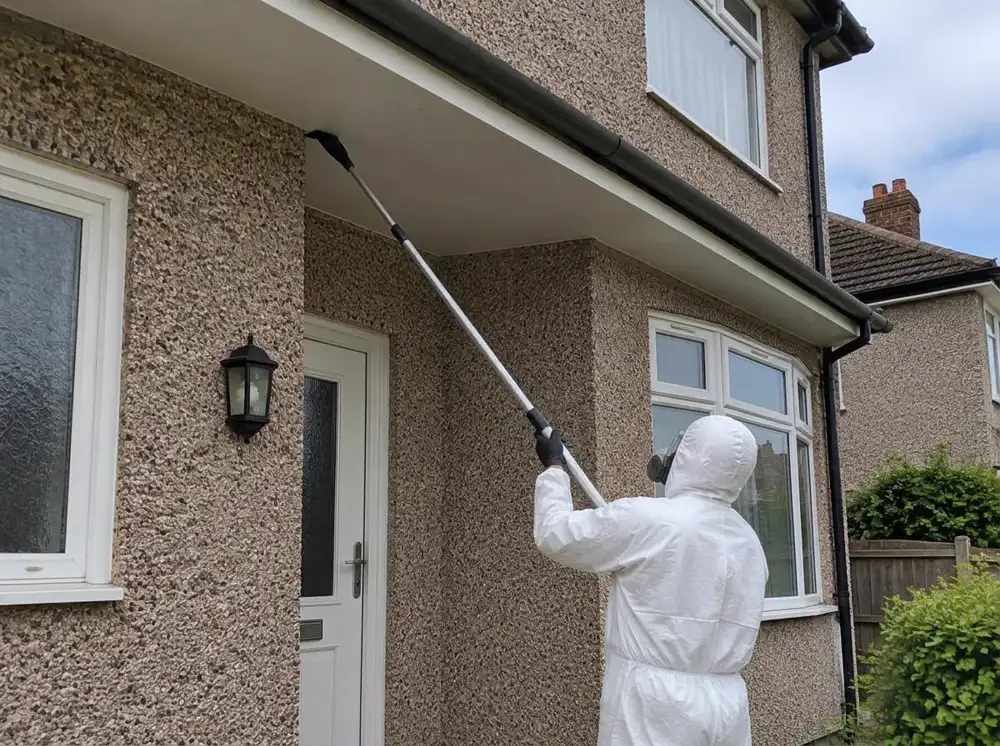
Our treatment page explains identification, entrance assessment, targeted application and after-care. Nests are treated from the ground using a telescopic pole. Product choice follows the authorised label and the circumstances. Keep children and pets away from the treatment area and tell us about ponds, animal enclosures and spaces that need to remain in use. Specific precautions are more useful than a blanket statement that every product is harmless.
The pricing page explains our phone-confirmed fixed price, no call-out fee and free revisit if the treated nest remains active. Mention multiple suspected nests or commercial premises before booking. Treatment aims to control the colony; it does not mean every concealed nest structure must be physically removed or that building repairs are automatically included. Clear scope matters as much as a clear price.
After-care, prevention and sting advice
Leave a treated entrance open and follow the instructions given at the visit. Do not add other insecticides or try to remove the structure while activity continues. If regular entry and exit persists after 48 hours, contact us for the free revisit. The prevention guide discusses maintenance once inactivity is confirmed, rather than sealing a live nest into a building.
For a sting, move away from the insects and consult our first-aid guide. Breathing difficulty, throat swelling or collapse after a sting requires an immediate 999 call; do not wait for pest-control advice. For local service information, browse the borough pages and area directory, including our Ruislip base area. Advice and coverage information work together, but neither is an automatic booking.
Frequently asked questions
Which guide should I read first?
Start with identification if you are unsure whether the insects are bees, wasps or hornets. Then read the signs of a nest and the relevant location page without approaching or disturbing the entrance.
Do several wasps mean I have a nest?
Not necessarily. Wasps can gather at food, flowers or water away from their nest. Repeated entry and exit at one opening is a more useful clue than insects feeding in the garden.
Can a guide confirm a hidden nest?
No. The guides explain common signs and safe observations, but noise or occasional indoor insects can have more than one explanation. Do not open a void or block a hole to test a theory.
Where should I report an Asian hornet?
Report suspected Asian hornets to the GB Non-Native Species Secretariat through the Asian Hornet Watch app. We do not treat Asian hornets. Keep away from suspected nests and do not attempt to destroy them.
Is leaving a wasp nest an option?
It can be reasonable where the nest is away from people and the risk can be managed. Colonies are seasonal, but location, access and a known sting allergy can affect whether treatment is appropriate.
For advice about your property, call 020 8419 8769. Describe the activity from a safe distance and leave any entrance undisturbed while you seek advice.
Speak to a technician, not a call centre.
Fixed price on the phone. No call-out fee. Free revisit if the nest is still active.