
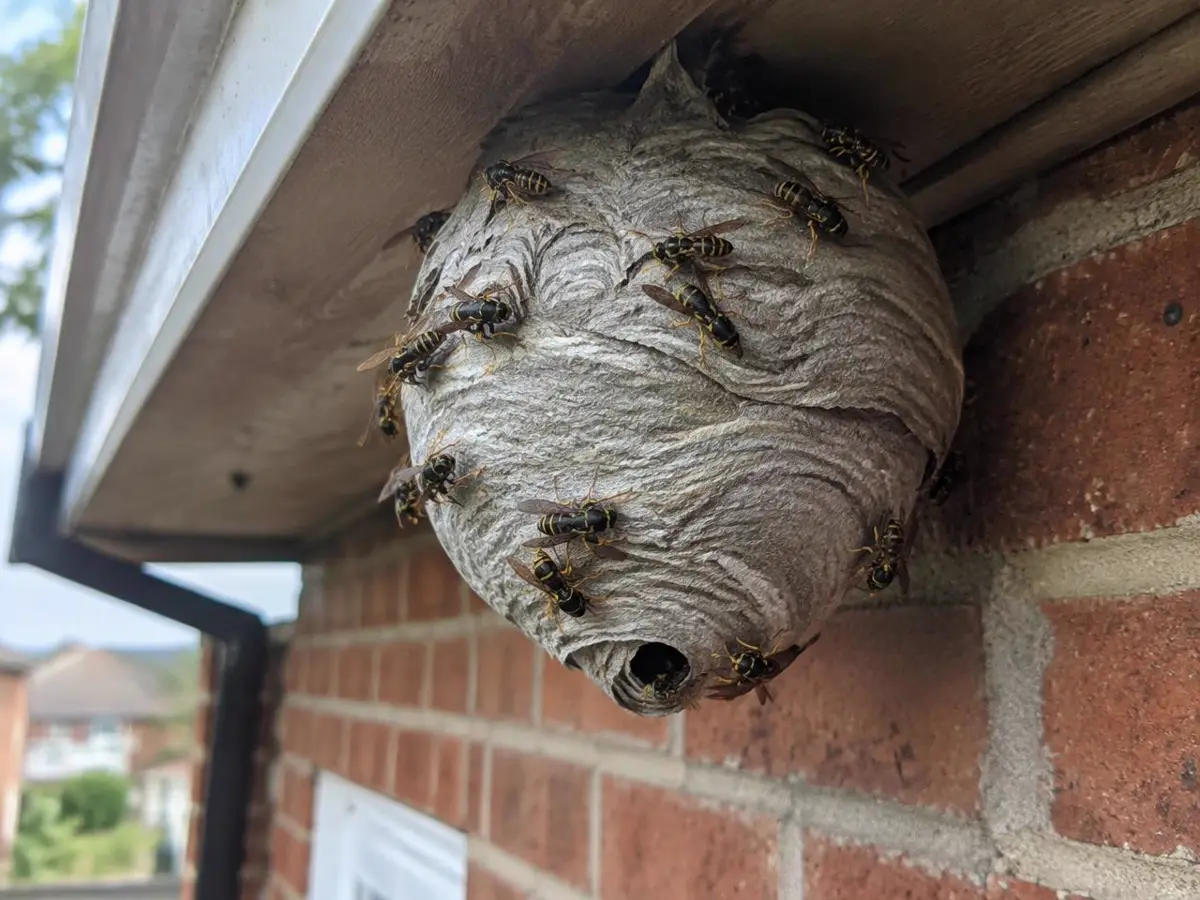
How can I tell if there is a wasp nest?
Repeated wasps entering and leaving one precise hole are a stronger sign of a nest than occasional insects around food or flowers. Watch from a safe distance without blocking the flight line. A concealed nest can sit behind the opening in a soffit, loft, wall or underground.
The strongest clue is a repeated flight line
A regular stream of wasps entering and leaving the same opening is one of the clearest signs of a nearby nest. The opening may be beneath roof tiles, at a soffit edge, in a shed or at ground level. You do not have to see the paper structure to suspect an active colony.
Observe from a safe place away from the flight path. Do not stand directly below an entrance or follow insects into dense planting. Note where the opening is in relation to a door, window or recognisable feature so that you can describe it later. There is no need to count insects or make a close-up recording.
Foraging is not the same as nesting
Wasps visiting flowers, fallen fruit, a pond or an outdoor meal may be collecting resources rather than living nearby. Their paths can look busy without repeatedly converging on a building opening. A single insect in a kitchen also does not establish that a colony is inside the house.
Reduce food attractants by clearing spills, covering drinks and closing bin lids. Then consider whether there is a consistent route to a specific place. Gardens close to Middlesex parks and mature planting will naturally have insect traffic. Treating an imagined nest will not prevent visiting wasps from surrounding gardens, so the distinction matters before arranging wasp control.
Paper nests and hidden structures
An exposed social wasp nest has a papery appearance because the insects use chewed wood fibres to make it. It may be small early in development and expand as the colony grows. Many nests, however, are concealed in voids, so the absence of visible paper does not rule out an active colony.
Do not pull back insulation, prise off soffit boards or lift tiles to find the structure. You may expose the colony or damage the property. A visible nest can also be old and empty, so paper alone is not evidence of current activity. Identification should combine what you can safely see with repeated movement at the entrance.
Sounds in ceilings and walls
A faint rustling or scratching sound may draw attention to a roof or wall void, but sound is not a reliable diagnosis on its own. Buildings carry noises from pipes, birds, rodents and ordinary movement. Hearing something above a ceiling should prompt careful observation from outside, not immediate drilling or application of a pesticide.
Look for a corresponding flight line without going into the space to listen more closely. If the sound is near a bedroom or an area where wasps are appearing indoors, mention both details when seeking advice. Do not tap the surface to provoke a response. Disturbing a concealed colony can turn an uncertain clue into a direct sting risk.
Repeated wasps inside a room
Several wasps appearing in the same room can indicate a nearby nest or access route, although open windows and attractive food can also explain indoor visitors. Note whether they appear around a particular ceiling edge, light fitting or window. Keep people away from that spot and avoid dismantling fittings to investigate.
If insects are entering from a building void, blocking the outside entrance can make matters worse by encouraging alternative routes. Do not seal cracks or spray into electrical fittings. Call for advice and explain the frequency and location of sightings. If a room cannot be used without close contact, keep it out of use where practical until the situation is assessed.
Where to look around Middlesex homes
A ground-level visual check can include roof edges, vents, sheds and areas of garden that people normally use. In 1930s semis, extensions and eaves offer several possible sheltered routes. In Victorian terraces, roof details and narrow shared passages can make the entry point less obvious from a single viewpoint.
Ground nests may be associated with existing holes and can be hidden by grass or planting. Do not mow, dig or cut a hedge where repeated wasp traffic is apparent. Warn anyone due to carry out maintenance. An opening near a public path or communal garden should also be reported to the responsible owner or manager so other people are not inadvertently exposed.
Check that the insect really is a wasp
Wasps, bees and hoverflies are frequently confused. Colour alone is insufficient, and some bees are less hairy than people expect. Honeybees may form a visible swarm cluster; bumblebees can use cavities around buildings. We never treat bees and direct bee enquiries to local beekeepers or BBKA swarm collectors as appropriate.
European hornets are larger insects with reddish-brown and yellow colouring. A suspected Asian hornet typically looks darker, with yellow leg tips and a broad orange band towards the rear of the abdomen. Report suspected Asian hornets to GB NNSS using the Asian Hornet Watch app. Do not approach a suspected nest to improve a photograph or attempt to treat it.
When the signs warrant a call
Seek advice when there is persistent entry near a doorway, activity beside a play area, repeated indoor wasps or a household member with a known sting allergy. We are based in Ruislip, Middlesex. Treatment is from the ground with a telescopic pole, with one fixed price given on the phone, no call-out fee and a free revisit.
While waiting, keep children and pets away and leave the entrance alone. If someone is stung, move away before providing first aid. Breathing difficulty, swelling of the mouth or throat, faintness or collapse requires 999 immediately and prescribed adrenaline as directed. Do not delay medical care while trying to identify or locate the nest responsible.
Frequently asked questions
Can I have a nest without seeing paper?
Yes. The nest may be concealed within a roof, wall or ground cavity, with only its entrance visible.
Does scratching prove there are wasps?
No. Building noises have several possible causes. Look for external flight activity without opening or disturbing the void.
Are wasps on flowers a nest sign?
Not on their own. They may be foraging from a colony elsewhere.
Should I plug a busy hole?
No. Blocking an active entrance can divert wasps into other routes, including occupied rooms.