
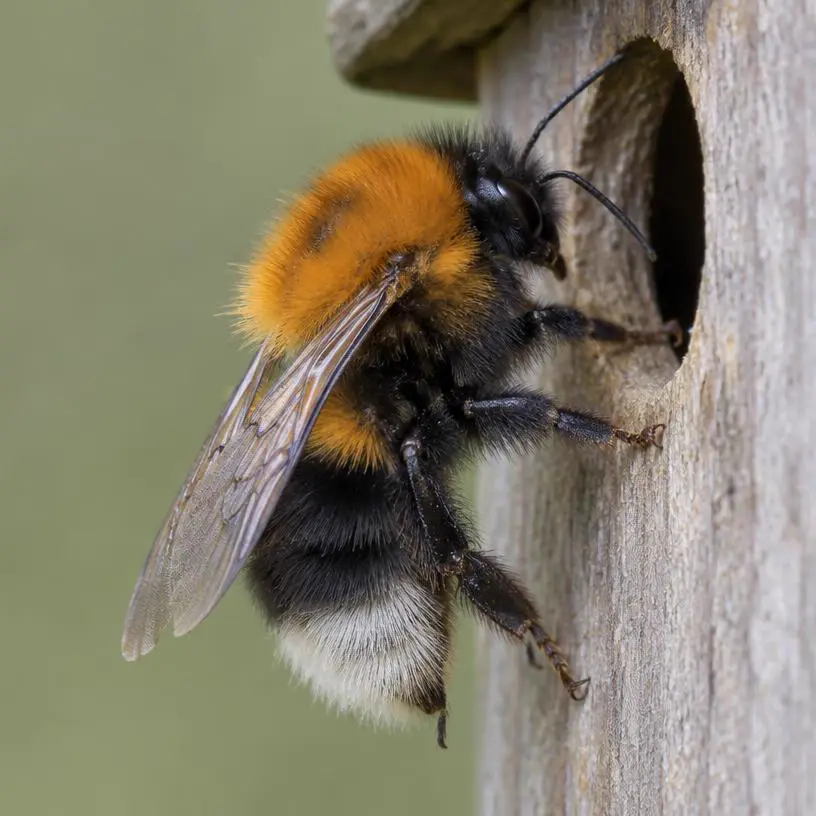
If you are seeing lots of buzzing insects around your roof, a bird box, a wall or your lawn in April or May, the chances are they are bees, not wasps. This is the spring bee mix-up, and it accounts for most of the calls we get at this time of year. Wasp nests in spring are small and quiet, with just one queen doing all the work. A busy, buzzing spot in April or May is almost always bees. Here's how to tell, and what to do.
Bee or wasp? Quick check
1 / 3Where are you seeing them?
Why spring is bee season, not wasp season
Wasp queens come out of hibernation in spring and each one starts a new nest on her own. Through April and May that nest is usually no bigger than a golf ball or a tennis ball, and you will see just one wasp, or a handful, coming and going. The big, busy wasp nests people worry about come later, from mid-summer onwards.
Bees are different. Several common bees are at their busiest in April and May, and they nest in exactly the places people expect to find wasps: roofs, walls, bird boxes and lawns.
The bees we're most often called out to in spring
- Tree bumblebees. Ginger-brown thorax, black body and a white tail. They love bird boxes, soffits and roof spaces. In late spring you'll often see a small cloud of them "dancing" outside the entrance — these are males waiting for new queens, and they don't sting. Colonies are short-lived and usually finish by mid-summer.
- Other bumblebees. Large, round and fuzzy. They nest in old mouse holes, compost heaps, under sheds and decking, and in loft insulation. Gentle, and usually left alone.
- Mining bees. Small, often reddish-brown or dark bees that make little volcano-shaped mounds of soil in lawns and borders. Each mound is a single bee's burrow. They're harmless, and gone within a few weeks.
- Mason bees and hairy-footed flower bees. Small bees going in and out of holes in old soft mortar or brickwork, often on a sunny wall. Lots of them can look alarming, but each one is nesting alone.
- Honeybee swarms. A large cluster of thousands of bees hanging from a branch, fence or wall, usually in May or June. A swarm is resting while scouts find a new home. Don't spray it — contact a swarm collector through the British Beekeepers Association (bbka.org.uk/swarm).
How to tell bees from wasps at a glance
Not sure? WhatsApp us a photo or short video — we can usually tell in minutes.
- Fur or shine: bees look fuzzy; wasps look smooth, shiny and sharply yellow-and-black.
- Shape: bees are round and chunky; wasps have a narrow "waist".
- Numbers in spring: lots of insects at one spot in April or May points to bees. A spring wasp nest has one queen and, at most, a few workers.
- Behaviour: bees visit flowers; wasps in spring are more often seen scraping wood from fences and sheds to build their nest.
Why we won't treat bees
Bees are important pollinators, and most bee nests are harmless, short-lived and best left alone. We never treat bees. If you call us and it's bees, we'll tell you what you've got, explain what to expect, and point you to a beekeeper if they need moving.
When it really is wasps in spring
Sometimes it is a wasp nest — and spring is the best time to deal with one. The nest is small, the colony hasn't built up, and treatment is quick. Signs it's wasps: a single smooth, yellow-and-black insect repeatedly going into one gap in a soffit, shed or loft; a small grey papery nest about the size of a golf ball in a shed or roof space. Treatment is the same £129 fixed price, with no call-out fee and a free revisit.
Not sure? Send us a photo
Call 020 8419 8769 or WhatsApp a photo or short video. A technician will tell you whether it's bees or wasps — and if it's bees, we'll tell you so rather than sell you a treatment.
Frequently asked questions
Why are there bees going in and out of my bird box?
Almost certainly tree bumblebees. They often take over bird boxes in spring. They're gentle, and the colony usually finishes by mid-summer, so the best option is to leave them.
There are lots of small holes and mounds in my lawn. Is it wasps?
Very unlikely. Small volcano-shaped mounds in spring are usually mining bees. They're harmless and gone within a few weeks.
Should I spray bees in my wall?
No. Bees in old mortar are usually solitary mason bees or flower bees. They're harmless, and spraying them won't stop them.
How do I know if it's a wasp nest in spring?
Look for one smooth, yellow-and-black insect going in and out of a single gap, or a small grey papery nest about the size of a golf ball. Send us a photo if you're unsure.