
Nest location guide
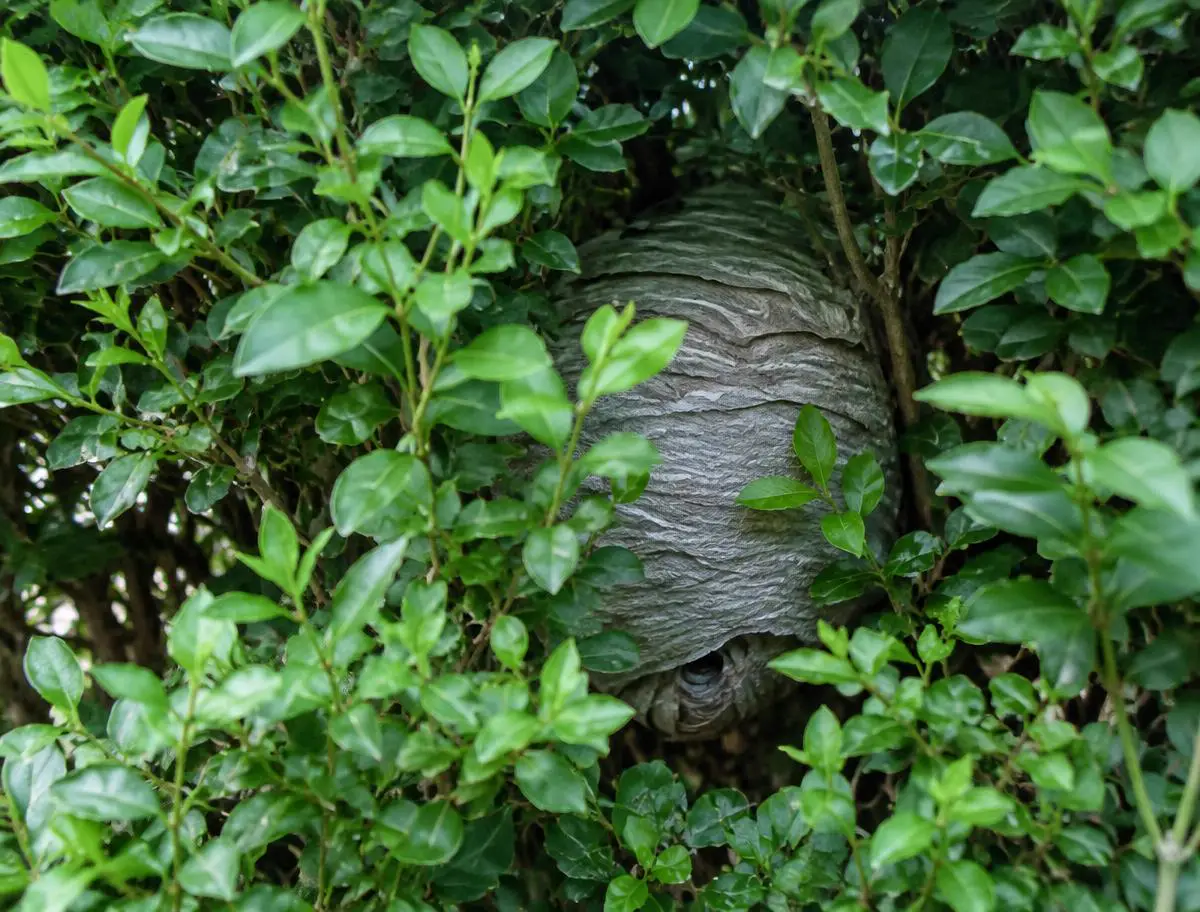
A wasp nest in the hedges and trees
A papery nest can be hidden inside a hedge, while European hornets may occupy a hollow trunk. Put hedge cutting on hold if insects keep entering one spot; do not part branches or probe the cavity.
One message and a technician confirms the price and a time to visit.
What should I do about a nest in the hedges and trees?
- Stop hedge trimming and tree work near the entrance
- Do not shake branches or probe a hollow trunk
- Never seal a living tree cavity to trap insects
How is this nest treated?
We locate the nest entrance without cutting into the vegetation, identify the species and check wildlife nearby. A reachable opening or exposed nest is treated from the ground with a telescopic lance and a suitable targeted application.
How long does treatment take to work?
Treated hedge or tree colonies normally quieten in 2–3 hours and become fully inactive within 24 hours. Leave pruning on hold until nest traffic has ended.
Paper nests in foliage and colonies in hollow wood
Branches provide supports for an aerial paper nest, while a hollow trunk offers an enclosed chamber for some wasps and European hornets. Dense leaves can screen a substantial nest from view until trimming begins.
Wasps covering leaves across a broad area may be feeding on aphid honeydew instead. A colony is indicated by a repeated route into one sheltered point, not by insects scattered through the canopy.
Warning signs before hedge cutting
Look along the hedge from a safe position for insects repeatedly vanishing into the same opening. Around a tree, note a fixed hole receiving traffic rather than occasional visitors to bark or blossom.
Tell the gardener or tree contractor which section is affected before they arrive. Power tools can mask the early warning buzz and put a blade into a concealed paper nest within seconds.
Why shaking or cutting is the wrong test
Parting branches brings hands and face close to defending workers. A tap on a hollow trunk or a pruning cut can disturb the colony even though no nest is visible outside.
Do not spray the hedge indiscriminately: foliage, nearby people and other wildlife can be exposed without the treatment reaching the nest. Keep a route clear around the affected section rather than attaching a marker beside the entrance.
Targeted treatment with the tree left intact
We assess the flight entrance, the species and the presence of active bird nests or other sensitive wildlife. For a suitable reachable target, the technician uses a telescopic lance from the ground to apply treatment directly at the nest or its access opening.
We do not hollow out a trunk or strip a hedge to find the colony. Suspected Asian hornets belong with GB NNSS: report them through the Asian Hornet Watch app and leave the suspected nest undisturbed.
Allow a full day before resuming vegetation work
Activity usually drops away over 2–3 hours after treatment, with the colony fully inactive within 24 hours. European hornet visitors can be active later in the day, so keep the treated tree section undisturbed through the settling period.
Check for continuing entrance traffic before rescheduling pruning. If the treated opening still has workers coming and going after a day, contact us about the free revisit.
Old paper nests, cavities and next year’s checks
An empty nest concealed in foliage need not be removed to prevent reuse, though a reachable paper shell can be cleared during later gardening. Material deep in a tree cavity is normally left alone.
Do not plug a living tree hollow as routine prevention: an arborist should advise on the tree’s condition. Before next season’s hedge cuts, spend time watching for a fixed flight entrance and retain room to work without leaning into dense foliage.
Frequently asked questions
Are large insects at my tree always Asian hornets?
Native European hornets also use tree hollows; identification must use the insect’s features, not size alone.
Do I have to cut the hedge back for you?
Keep the branches as they are so the colony is not disturbed before we assess its entrance.
Can an empty tree nest be left inside the trunk?
A dead colony does not need extracting simply to prevent reuse, and cutting into a living trunk can cause unnecessary damage.
Treatment and local advice
How nest treatment works · Wasp and hornet guides · Find your town
Price
£129 fixed price, wasps or hornets. No call-out fee. Free revisit if required. See how pricing works.
Other nest locations
Speak to a technician, not a call centre.
Fixed price on the phone. No call-out fee. Free revisit if the nest is still active.