
Nest location guide
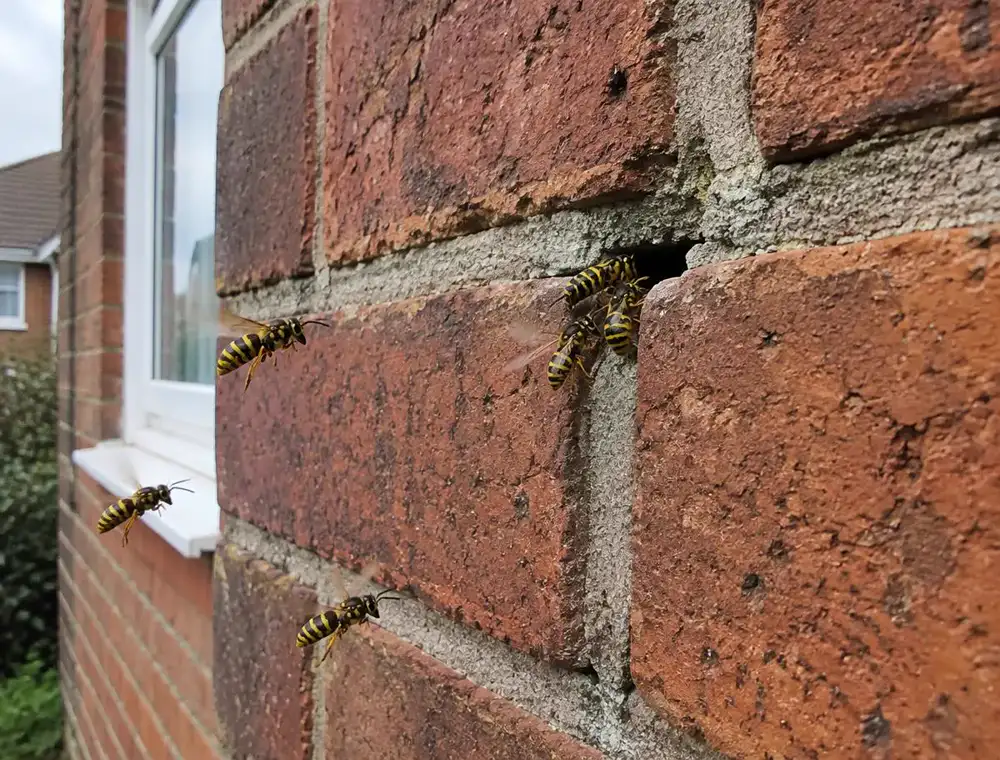
A wasp nest in the wall cavity
A narrow mortar gap or an opening beside a pipe can lead to a wasp nest inside the wall. Keep the brickwork intact and the entrance open: blocking it can send the insects towards the inside of the house.
One message and a technician confirms the price and a time to visit.
What should I do about a nest in the wall cavity?
- Do not drill the wall to find the nest
- Leave occupied mortar and pipe gaps unsealed
- Do not remove sockets or internal wall panels
How is this nest treated?
We identify the external cavity entrance and direct insecticidal dust into the wasps’ access route. A telescopic lance reaches higher openings from the ground without drilling or dismantling the wall.
How long does treatment take to work?
Cavity nests normally go quiet within 2–3 hours, with full inactivity within 24 hours. Report any continuing wall-entry traffic the next day.
Entry through mortar, pipework and wall junctions
A missing section of pointing, a poorly sealed service pipe or a gap where an extension meets the original house can admit a queen. Inside the cavity she has a protected space between the wall leaves, and workers may follow a short passage before reaching the actual nest.
The visible entrance is therefore a treatment target, not a reliable map of where to open the wall. Cavity insulation and concealed services make exploratory drilling particularly unhelpful.
Recognising a concealed wall colony
A steady stream disappearing into the same mortar defect is the clearest external sign. Wasps merely landing on warm bricks or searching several cracks do not establish an occupied cavity.
Indoors, insects appearing repeatedly at a window reveal or near a fitting can indicate another route from the void. Keep the affected room out of use and tell us about it; leave electrical covers and pipe boxing untouched.
Why sealing and spraying can make matters worse
Foam, cement or tape can close the outside route while leaving a live colony trapped behind it. Workers then search for other exits, which can lead through defects towards occupied rooms.
A household spray at the face of the brickwork often reaches only passing insects. Drilling to inject it risks services and building fabric, without ensuring that the treatment reaches the colony.
Getting treatment into the cavity entrance
We watch the flight line, confirm wasps rather than bees and select an application suitable for the opening and nearby materials. Insecticidal dust is placed into the active access point, with a telescopic pole for entries above ground reach.
Workers moving through the treated passage transfer the dust into the hidden nest. Our normal method leaves pointing, insulation and plasterboard in place; any necessary building repair follows treatment rather than providing access to it.
What a successful cavity treatment looks like
Wall-entry traffic usually subsides in 2–3 hours and the colony becomes fully inactive within 24 hours. Leave the passage unblocked throughout that period so returning insects encounter the treatment.
Watch outside the next day without touching the brickwork. Ongoing repeated entry, or wasps still emerging indoors after 24 hours, should be reported for our free revisit assessment.
Removal and future pointing repairs
An inaccessible paper nest normally remains in the cavity once dead, because wasps do not rebuild in the old nest. Opening a sound wall just to remove it is not routine treatment.
Repair failed pointing and service seals after inactivity has been checked. A builder should preserve cavity drainage, weep holes and intended ventilation rather than closing every small opening along the elevation.
Frequently asked questions
Will you have to drill into my cavity wall?
Our first approach uses the existing external flight route, so exploratory drilling is not required for a normally accessible entrance.
What if the wasps are coming through a window reveal?
Keep people out of that room and describe the indoor exit as well as the external wall entrance when contacting us.
Can I repoint the occupied hole today?
Hold the pointing work until treatment has taken effect and no colony traffic remains; premature cementing can redirect live workers indoors.
Treatment and local advice
How nest treatment works · Wasp and hornet guides · Find your town
Price
£129 fixed price, wasps or hornets. No call-out fee. Free revisit if required. See how pricing works.
Other nest locations
Speak to a technician, not a call centre.
Fixed price on the phone. No call-out fee. Free revisit if the nest is still active.