
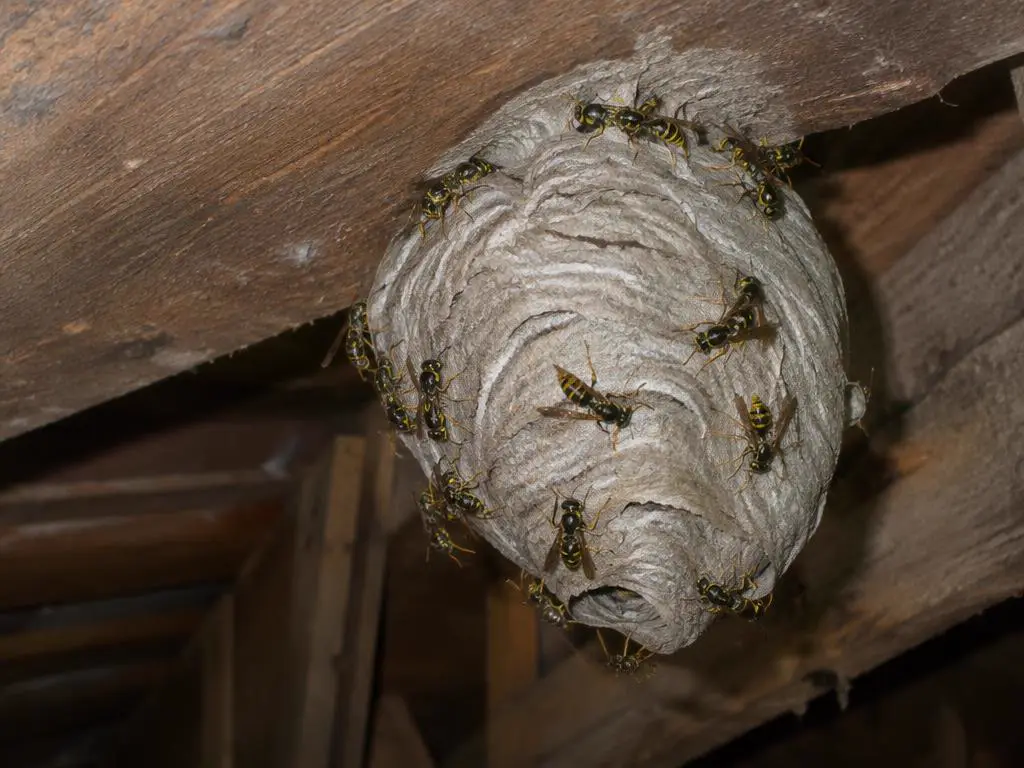
Can a wasp nest be left alone?
An undisturbed nest away from people may be left where the sting risk is manageable. A colony beside a doorway, play area or occupied room needs a different assessment. Wasp colonies are seasonal and do not reuse an old paper nest, but an active nest should not be handled or its entrance sealed.
Leaving a nest can be a reasonable choice
Finding a wasp nest does not automatically mean it must be treated. Wasps are part of the local ecosystem and workers catch other insects to feed their developing young. A colony in a quiet, unused corner can sometimes complete its season without coming into conflict with the people living nearby.
The decision is about location and exposure, not simply whether you dislike wasps. An entrance beside a front door creates a different situation from one beyond an unused boundary. Look at who uses the area, whether they can reliably avoid it and whether nearby maintenance will disturb the nest. Do not approach it just to decide how large it looks.
What happens during spring and summer
A queen begins a new paper nest after emerging from winter shelter. Initially she works alone; once workers emerge, they take on foraging and nest duties while the colony develops. Activity can increase substantially during the warmer months, although weather, available food and the species affect its pace.
A nest that causes little inconvenience early on may later have a busier flight line across a path or patio. If you leave it, check the practical arrangements from a distance as the season progresses. Do not assume that a small visible patch of paper represents the whole nest, especially inside a wall cavity or behind roof lining.
Autumn decline is not a fixed deadline
Later in the season, established colonies produce males and new queens. Mated queens seek sheltered places to overwinter away from the old nest. The old queen and workers eventually die, and the annual colony comes to an end. This is not the same as every wasp disappearing on a particular day in autumn.
Mild weather can allow activity to continue later than expected. A cold or wet morning may temporarily suppress flying without proving the nest is dead. Base safety decisions on actual activity and professional advice, not a month on the calendar. There is no need to disturb the nest to test whether the seasonal decline is complete.
Will the nest be used again?
Common social wasps do not reuse the old paper nest in the following year. An abandoned structure may remain in a dry loft for a long time, but it is not itself a living colony waiting to restart. New queens build fresh nests when conditions allow, sometimes in the same wider roof space.
Leaving the old structure does not guarantee that the property will be avoided next spring. Equally, removing it does not guarantee prevention. Suitable gaps and sheltered voids can remain attractive. Once activity has ceased and access is safe, building maintenance may reduce future opportunities without requiring every piece of old paper to be removed.
Middlesex gardens, houses and shared spaces
In a 1930s semi, a nest under eaves may be well away from people or directly above an often-used side passage. Victorian terraces can have small gardens where even a modest exclusion area is hard to maintain. Think about the actual route people take, including neighbours using adjoining gardens or shared access.
Parks, mature hedges and trees support insects, so seeing wasps near a Middlesex garden is normal and does not by itself justify treatment. A ground nest beside a mowing route or a shed entrance can be more problematic because accidental disturbance is foreseeable. Where land is communal, involve the owner or managing agent before deciding to leave the colony undisturbed.
When the balance favours calling for help
Ask for assessment if wasps repeatedly enter occupied rooms, the entrance is beside an unavoidable doorway or the colony is close to a play area. A person with a known sting allergy may make separation especially important. Do not ask them to observe the nest or rely on their medication as a reason to accept avoidable exposure.
Our business is based in Ruislip, Middlesex. Where treatment is appropriate, nests are treated from the ground with a telescopic pole. We give one fixed price on the phone, with no call-out fee and a free revisit. Explain the location and the reason it is difficult to avoid rather than trying to expose the nest before the visit.
Keeping a live nest undisturbed safely
Keep children, pets and visitors away from the entrance and its approach route. Postpone hedge cutting, drilling, shed clearing or other work that might affect the nest. Do not seal the opening: blocking access to a live colony can result in insects finding an alternative route, including towards occupied parts of a building.
Keep food, sweet drinks and waste covered to reduce unrelated foraging close to seating. Never use a trap beside the nest as a way to make approaching it safe. If stung, move away first. Call 999 for breathing difficulty, mouth or throat swelling, faintness or collapse, and use a prescribed adrenaline auto-injector as directed.
Check identification before deciding
An insect colony in a wall or roof might be bees rather than wasps. Bumblebees and honeybees need different advice, and we never treat bees. A hanging cluster of honeybees may be a swarm, for which a local beekeeper or BBKA swarm collector is the appropriate source of help.
A suspected Asian hornet or its nest should be reported to GB NNSS through the Asian Hornet Watch app; do not treat or disturb it. European hornets are native and a remote nest may be left alone if risk is manageable. Identification from a safe photograph is more useful than a close inspection that exposes you to defensive insects.
Frequently asked questions
Does every wasp nest die in winter?
The annual colony declines and dies, while new mated queens overwinter elsewhere. Timing varies with weather and species.
Will next year’s wasps reuse the paper nest?
No. They build new nests, although the same roof space may provide suitable shelter again.
Can I leave a nest above a doorway?
An unavoidable busy entrance warrants advice because maintaining safe separation may be difficult.
Should I block the hole once activity slows?
Do not block an active entrance. Get advice if you are unsure whether the colony has finished.