
About
About our Ruislip-based wasp nest service
Based in Ruislip, Middlesex, we help households and businesses make sensible decisions about wasp and hornet nests.
One message and a technician confirms the price and a time to visit.
A Middlesex base and a practical purpose
Wasp Nest Removal Middlesex is based in Ruislip. Our service is focused on wasp nests and appropriate European hornet nest treatment across the area described on this site as historic Middlesex. That includes homes, gardens, outbuildings and business premises. The purpose of an enquiry is to understand what is happening and whether action is needed, rather than to treat every insect sighting as an urgent problem.
The name Middlesex is still widely used in local addresses, even though modern administrative boundaries divide the historic county between different boroughs and neighbouring authorities. Our coverage pages use borough groupings and familiar town names to help you find relevant information. They are a directory, not a claim that we have an office in every town. Our base remains Ruislip, Middlesex.
Start with identification, not assumptions
A yellow-and-black insect is not automatically evidence of a wasp nest requiring treatment. Bees, hoverflies and wasps may visit the same flowers, and feeding activity can happen well away from a colony. Repeated traffic into one opening is more informative than a single sighting. We ask what you have seen and where, without expecting you to approach an entrance or identify an insect at close quarters.
Our bee or wasp guide explains some useful distinctions. Photographs can support a discussion when taken safely, but they are not a reason to climb, open a void or stand in a flight line. If identification remains uncertain, that uncertainty should be acknowledged rather than converted into a confident treatment recommendation.
When doing nothing can be reasonable
Wasps are predators of other insects and part of the local environment. A nest away from people may be left undisturbed where the risk can reasonably be managed. Social wasp colonies are seasonal, and an old nest is not normally reused. That does not make every active nest safe to ignore: a position beside a busy doorway or play area can change the decision. Our guide to leaving a nest alone provides a starting point.
Clear pricing and an agreed scope
We give one fixed price on the phone before booking. There is no call-out fee, and a free revisit is included if the treated nest remains active. We do not publish invented example bills or use a headline figure that cannot explain your circumstances. The enquiry is the place to mention multiple suspected nests, a commercial site or access restrictions so that the agreed work is understood.
Our pricing page explains what treatment covers and what questions to ask when comparing services. Good communication includes knowing which nest is being treated, what after-care means and when to contact us again. If you are arranging the work on behalf of someone else, make sure the person at the property receives the same instructions and can keep the relevant area clear.
Targeted treatment and sensible precautions
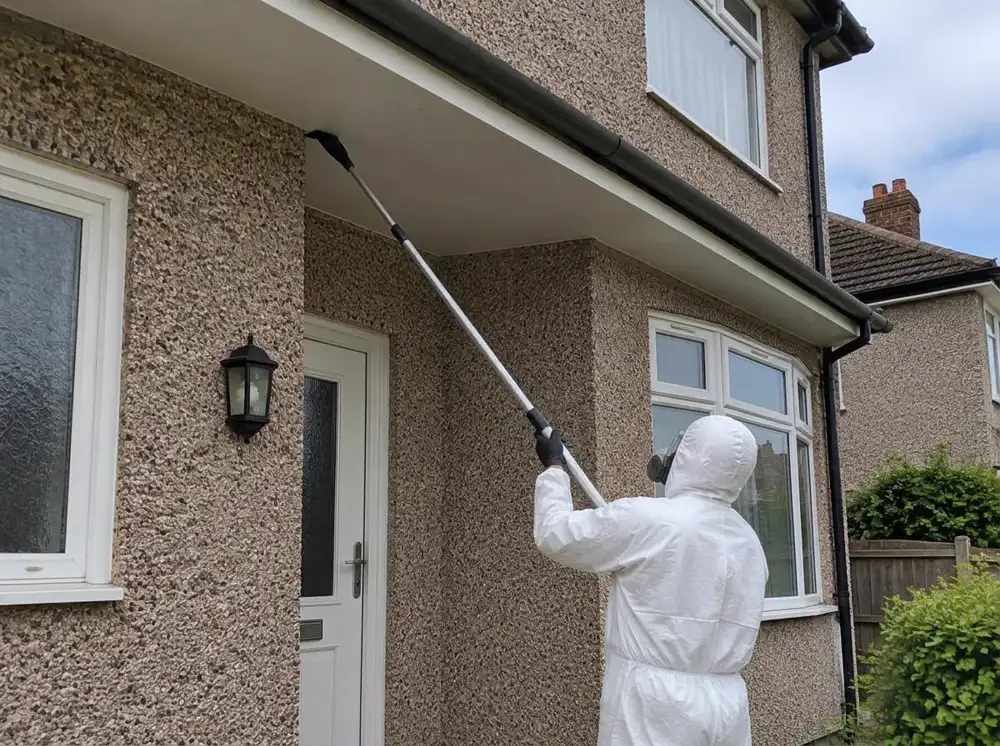
We treat nests from the ground using a telescopic pole. Before treatment, the entrance and surrounding activity need to be understood. Product choice and application must follow the authorised label and suit the location. The aim is targeted control of the colony, not indiscriminate spraying of a garden or the removal of every visiting wasp.
Children and pets should be kept away from the treatment area, with any further precautions explained for the product and surroundings. Tell us about ponds, animal enclosures and spaces people need to use. We do not describe insecticides as harmless or offer a single return-to-area interval for every application. Read how treatment works for the sequence from identification through to after-care.
Practical advice after the visit
Leave an active entrance open and do not disturb it. Blocking a hole in a building can lead wasps to seek another exit, including into occupied rooms. Some activity may continue after treatment, so keep clear and observe only from a safe distance. If regular entry and exit at the treated nest continues after 48 hours, contact us for the free revisit instead of applying another product yourself.
The papery structure does not always need physical removal. Once inactivity is confirmed, building maintenance can help close suitable gaps before a later nesting season. No repair can promise that a wasp will never visit the property again. Our prevention advice distinguishes useful maintenance from claims of complete protection.
Firm boundaries: bees and Asian hornets
We never treat bees. A suspected honeybee swarm should be discussed with a local beekeeper or BBKA swarm collector. Bumblebees and other bees need different advice and are not automatically suitable for collection. Do not seal an active bee entrance or spray it while waiting for identification. Protecting people starts with avoiding the wrong intervention as well as carrying out the right one.
European hornets are native insects; a nest may merit treatment where it presents a risk to people. Suspected Asian hornets follow a different route entirely. Report sightings to the GB Non-Native Species Secretariat through the Asian Hornet Watch app. We do not treat Asian hornets. Keep away from a suspected nest and do not attempt to capture or destroy the insects. Our Asian hornet guide points you towards the reporting process.
Local information without unsupported promises
Our pages are intended to explain ordinary UK wasp and hornet behaviour, treatment principles and the practical differences between nest locations. They are not a substitute for assessing your property, and we do not promise that every noise in a roof or every wasp indoors proves the same cause. A useful conversation leaves room for uncertainty and gives you a safe next step.
Use the location guides to describe whether activity is in eaves, a wall, an outbuilding or the ground. Use the coverage directory to check the town and postcode you are enquiring about. We would rather receive a clear description from a safe distance than have someone put themselves at risk trying to supply a perfect photograph or uncover the nest before calling.
Find advice for your property
Explore our wasp and hornet guides and nest location advice before disturbing an entrance. Our borough directory and area pages explain the coverage across Middlesex, including Ruislip. For advice about your own situation, call 020 8419 8769. Describe what you can see from a safe distance; there is no need to expose the nest to make an enquiry.
Frequently asked questions
Where is the business based?
We are based in Ruislip, Middlesex. The town and borough pages describe coverage, not separate branch offices. Give your postcode when enquiring so the property location can be checked.
Do you treat every wasp nest?
Treatment depends on identification, location and risk. A nest away from people may be left undisturbed. We discuss what you have observed rather than assuming every garden sighting needs action.
What are your pricing principles?
One fixed price is confirmed on the phone before booking, with no call-out fee and a free revisit if the treated nest remains active. Mention multiple nests or commercial premises during the enquiry.
Do you remove honeybee swarms?
We never treat bees. Contact local beekeepers or BBKA swarm collectors about suspected honeybee swarms. Other bee species may need different advice and may not be suitable for collection.
Can I send a photograph?
Yes, if it can be taken from a safe position without disturbing the insects. A description is preferable to approaching a nest, opening a building void or standing in the flight line.
Speak to a technician, not a call centre.
Fixed price on the phone. No call-out fee. Free revisit if the nest is still active.