
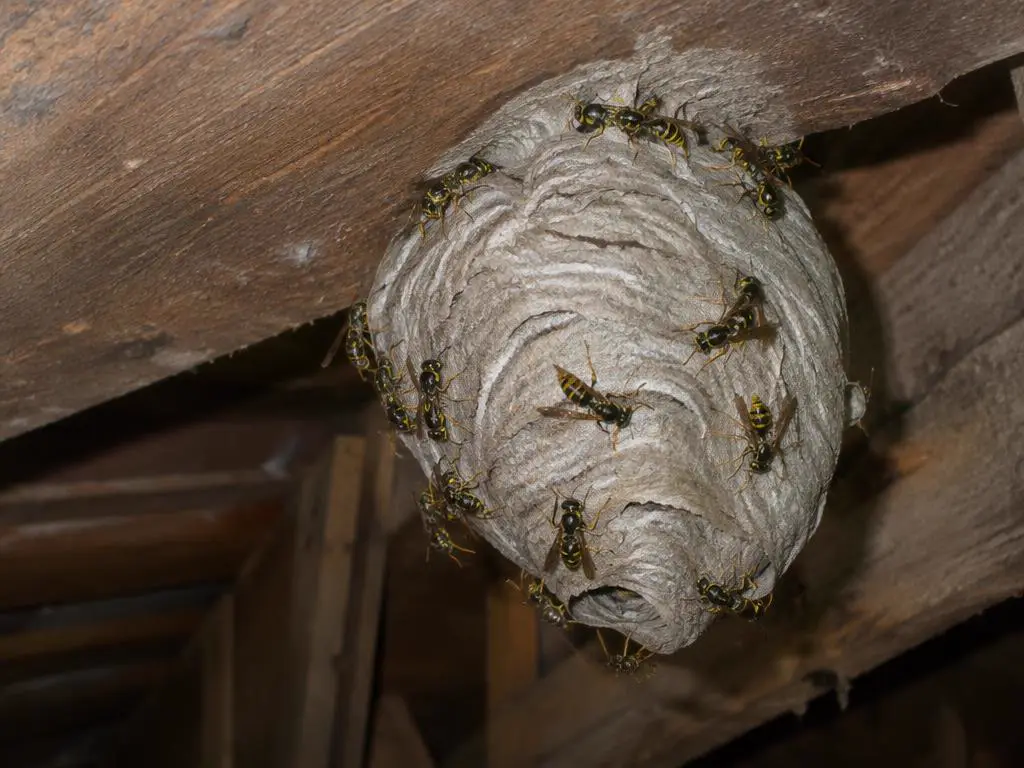
Usually, an old nest can stay
An old wasp nest is not reused by a new colony, so taking it down is not normally needed for pest control. The important first step is to establish whether it is genuinely inactive, without entering or disturbing the loft. If activity is uncertain, keep away and arrange an assessment rather than trying to remove or treat it yourself.
A nest visible among stored items may look papery, grey or weathered, but appearance alone cannot confirm that no wasps remain. Nor does an old nest mean the roof will never host another colony: a queen can select a different sheltered spot in a later season. Decide based on current activity, safety and any building defect—not simply the presence of the structure.
How to think about activity without entering
Do not climb into the loft, move boxes, lift insulation or approach a suspected nest to get a closer look. You do not need to inspect its surface or find the exact position to make a useful first report. From a safe place outside, note whether wasps repeatedly enter and leave one point on the roofline, soffit or another visible opening.
A few insects near the house do not prove that a nest is in the loft. Wasps may be foraging in the garden or passing through. Repeated traffic to a particular opening is more relevant, but even that does not reveal whether the nest itself is accessible, how large it is, or whether there is another route into the building. Do not use sound, a brief quiet spell or the lack of visible insects as proof that a nest is empty.
If you see wasps inside a room, or repeated flight at a roof opening, keep people and pets away from the area and tell others in the household. Do not block the opening, spray into it or seal gaps around it. Wasps in a concealed space may seek a different route, including indoors, and an improvised intervention can make the situation harder to assess.
Why certainty matters
A nest can become inactive as the colony’s seasonal cycle ends, but a suspected nest should not be treated as abandoned merely because it is late in the year or the weather has changed. The view from a hatch or a short observation is limited. If you cannot confidently tell whether wasps are still using the space, leave the structure undisturbed and ask a suitable pest professional for advice.
This is especially important where the loft hatch is awkward, access is restricted, the floor is not boarded, or stored belongings obstruct the route. A wasp nest is not a reason to take a fall risk or step on insulation or ceilings. Do not ask a child, neighbour or anyone with a known sting allergy to investigate. A clear description of the location and activity seen from outside is more useful than a close-up obtained by entering the loft.
If insects appear to be bees rather than wasps, do not assume ordinary wasp treatment is appropriate. Honeybees need different advice; contact a local beekeeper or BBKA swarm collector. A suspected Asian hornet should be reported to GB NNSS using the Asian Hornet Watch app, rather than handled as a routine wasp problem.
Removal is separate from treatment
Treating an active colony and physically removing its paper nest are different jobs. Where treatment is needed, a professional may be able to treat through the entrance from ground level with a telescopic pole; the precise approach depends on the site and safe access. This does not mean that the structure will be taken out of the loft. Opening a roof or dismantling building materials is not automatically part of pest treatment.
If activity has ceased, a nest in an undisturbed loft void often causes no practical problem and can be left in place. The paper structure may eventually dry and deteriorate. Removing it can involve entering a difficult space, shifting insulation or risking damage to stored items, wiring or the building. There is no general need to take those risks just to prevent reuse: wasps build a new nest rather than reuse an old one.
There may be a separate reason to remove accessible debris—for example, if it obstructs planned maintenance or is contaminated or damaged—but that is a building-maintenance decision, not a requirement to stop wasps returning. Do not disturb it as part of routine cleaning until inactivity and safe access are established. If removal would require opening a wall or roof, discuss the work with an appropriate contractor and consider whether it is necessary at all.
If wasps are still active
Repeated entry and exit, wasps emerging indoors, or activity beside a frequently used doorway warrants advice. Keep clear of the flight route and do not attempt DIY treatment, knock down the nest, vacuum insects or plug the entrance. A professional can assess whether a colony is active and whether treatment is warranted; a nest in a low-risk location may not need intervention.
For an active nest, treatment does not usually require the householder to enter the loft. Tell the adviser that the nest is believed to be in the loft, where the suspected entrance is, whether wasps have appeared indoors, and what can be observed from ground level. Mention restricted access, people who use the affected rooms and any known sting allergy. Do not move possessions or prepare the loft unless specifically advised and it is safe to do so.
If regular activity continues after treatment, follow the provider’s after-care instructions and contact them for reassessment. Do not add another insecticide or begin removing material while activity persists. If there is an immediate medical emergency after a sting—such as breathing difficulty, swelling of the mouth or throat, faintness or collapse—call 999.
Repairs and future prevention
Once inactivity is confirmed, look at whether there is a genuine building defect worth repairing, such as damaged fascia or a gap around a fitting. Repairing an accessible defect may reduce one opportunity for future nesting, but it cannot guarantee that wasps will not select another position. A queen may use a different sheltered cavity in a later year even if an old nest remains or is removed.
Never seal an opening while a colony might still be active. Do not fill roof vents, air bricks or other designed ventilation as a general deterrent. If repair requires roof access, work at height or alteration of a shared structure, use a suitably qualified contractor and agree responsibility with a landlord or managing agent where relevant.
For practical prevention, maintain the building sensibly and keep food and waste covered around outdoor living areas. These steps address different issues: tidy food sources can reduce foraging around people, while sound repairs can reduce accessible gaps. Neither is a substitute for assessing repeated traffic at a possible nest entrance.
Sources
Frequently asked questions
Will wasps use the old loft nest again?
No. A new colony does not reuse an old wasp nest, although a queen may build elsewhere in the same roof or property in a later season.
Should I remove an inactive nest?
Usually not. If it is confirmed inactive and causes no maintenance problem, leaving it in place avoids unnecessary disturbance. Removal is separate from treatment and may require specialist access.
How can I tell if the nest is still active?
Do not enter the loft to check. Note repeated traffic to a visible opening from a safe position, and seek professional advice if you cannot be sure. A quiet moment or old-looking paper is not conclusive.
Does treatment include taking the nest out?
Not necessarily. Treatment targets an active colony; removing the paper structure or opening a roof is separate work and is often unnecessary.