
Borough
Wasp nest removal in Harrow
Harrow’s sloping streets, Pinner’s older rooflines and Stanmore’s wooded garden edges call for different access plans. We treat the identified flight entrance and give clear advice on when you can resume using the area.
One message and a technician confirms the price and a time to visit.
Harrow Hill, Pinner and the suburban roofline
Harrow on the Hill has older properties on steep streets, where a roof opening seen from the road can sit much higher above the rear garden. Decorative eaves, chimney junctions and small roof additions provide sheltered entrances. Explain the elevation on which the wasps are active, not just the number of storeys at the front.
Pinner’s historic centre includes timber-framed buildings and older roof details, surrounded by suburban housing. Across Harrow, interwar semis, bungalows and maisonettes add soffit boxes, bay canopies and underfloor vents to the potential nest locations. A low bungalow entrance can be as disruptive as an upstairs roof gap when it sits beside a regularly used path.
Stanmore Common and garden boundaries near Headstone
Stanmore Common and the Harrow Weald edge have wooded surroundings that make tree cavities and established hedges worth watching before garden work. A concentrated stream entering a trunk hole deserves identification, particularly when the insects are large European hornets.
Near Pinner Memorial Park and Headstone Manor, wasps can also gather over planting or outdoor food without nesting in your building. Establish whether they repeatedly enter one roof joint or hedge opening before booking nest control; broad feeding activity needs different advice.
Shop parades and homes above commercial premises
Harrow town centre and Pinner’s cafés and shops bring nest entrances close to public doors, rear service passages and flats above businesses. Identify whether the opening is over the shopfront, in a rear wall or beneath the shared roof.
For a shared building, tell the owner or managing agent which elevation is affected and who can provide access. Staff should not shift fascia panels or climb into a roof void to show us the nest; the workers’ outside entrance is normally the useful target.
Harrow visits from Ruislip
Pinner lies near our Ruislip starting point and is among the closer Harrow-area journeys. Harrow and Stanmore are reached from the same base, with the day’s route and available booking determining when a visit can be made.
Mention steep steps, terraced gardens and a lower extension beneath the entrance when contacting us. A photograph showing the ground beneath the roof helps us assess the telescopic-lance approach more accurately than a cropped picture of insects alone.
Ground-based treatment on sloping plots
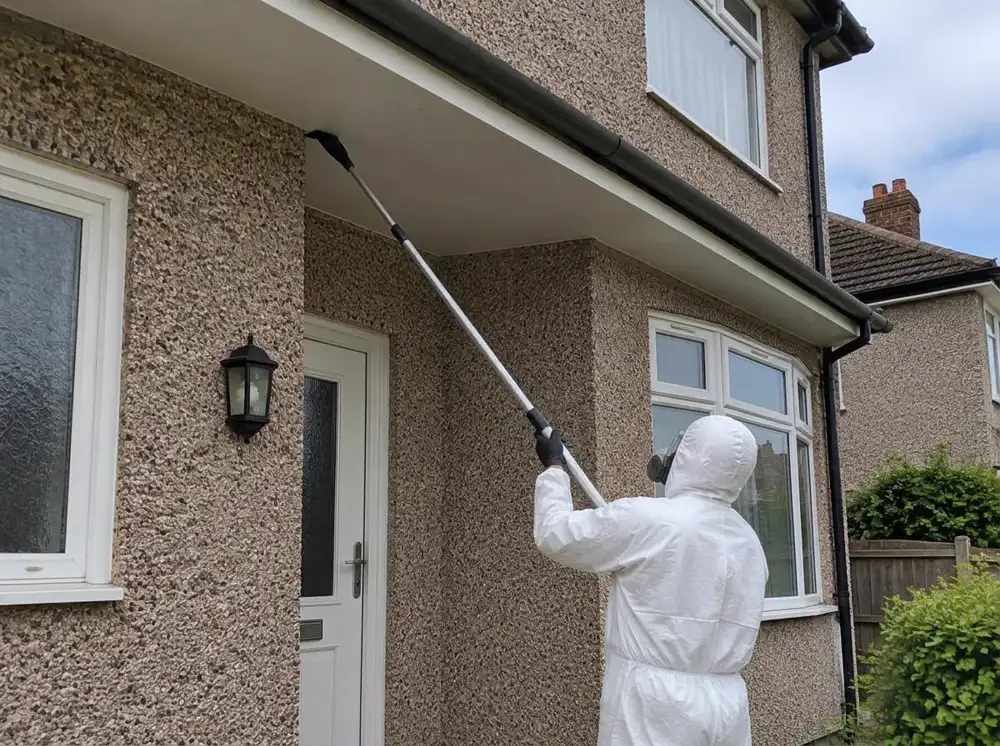
We select a safe standing position with a clear line to the occupied opening, then apply a suitable treatment through that route. A telescopic pole usually reaches roof entries from the ground; sloping land and obstructions are checked before making an access commitment.
Where the flight line crosses a front path, use an alternative route while treatment settles. Leave active joints unsealed and postpone hedge cutting or roof maintenance so workers can continue passing through the treated entrance.
The first day and later roof repairs
Expect a Harrow-area colony to go quiet over 2–3 hours, becoming fully inactive within 24 hours of treatment. Repeated nest traffic still present after that day is a reason to contact us about the included free revisit.
An empty nest inside decorative eaves does not need retrieving merely to prevent next year’s colony. Arrange repairs to failed timber joints after inactivity, with particular care around older or conservation-sensitive roof details and their ventilation.
Frequently asked questions
Can you assess a nest on a steep Harrow Hill plot?
Show the entrance from the side where treatment would take place, including the slope and any steps; we need a stable ground position for the lance.
Should a Pinner property have its old timber trim removed first?
Keep original roof details intact while the nest is active, since an existing flight joint often gives the required treatment access.
Are hornets beside Stanmore Common automatically a nest problem?
A large insect hunting in the garden may be visiting from elsewhere. Repeated entry into one tree cavity or building gap is the evidence to describe.
Discuss your property
Call 020 8419 8769. Read about our treatment method and fixed pricing and the free revisit, or browse identification and safety guides.
Nest-location guides
- Loft
- Eaves and soffits
- Wall cavity
- Air brick
- Chimney
- Shed and garage
- Garden and underground
- Hedges and trees
- Conservatory and bay roofs
Towns in this area
HA1 · HA2 · HA3
Harrow
On the Middlesex side, Harrow is dominated by the Hill, with its school and older houses, surrounded by interwar suburbs stretching to Wealdstone and Rayners Lane.
HA5
Pinner
Pinner is a historic village with a medieval high street, surrounded by interwar Metroland houses and leafy streets.
HA7
Stanmore
Stanmore on the Middlesex side has large detached houses, leafy roads and big open spaces at Stanmore Common and Bentley Priory.
Speak to a technician, not a call centre.
Fixed price on the phone. No call-out fee. Free revisit if the nest is still active.