
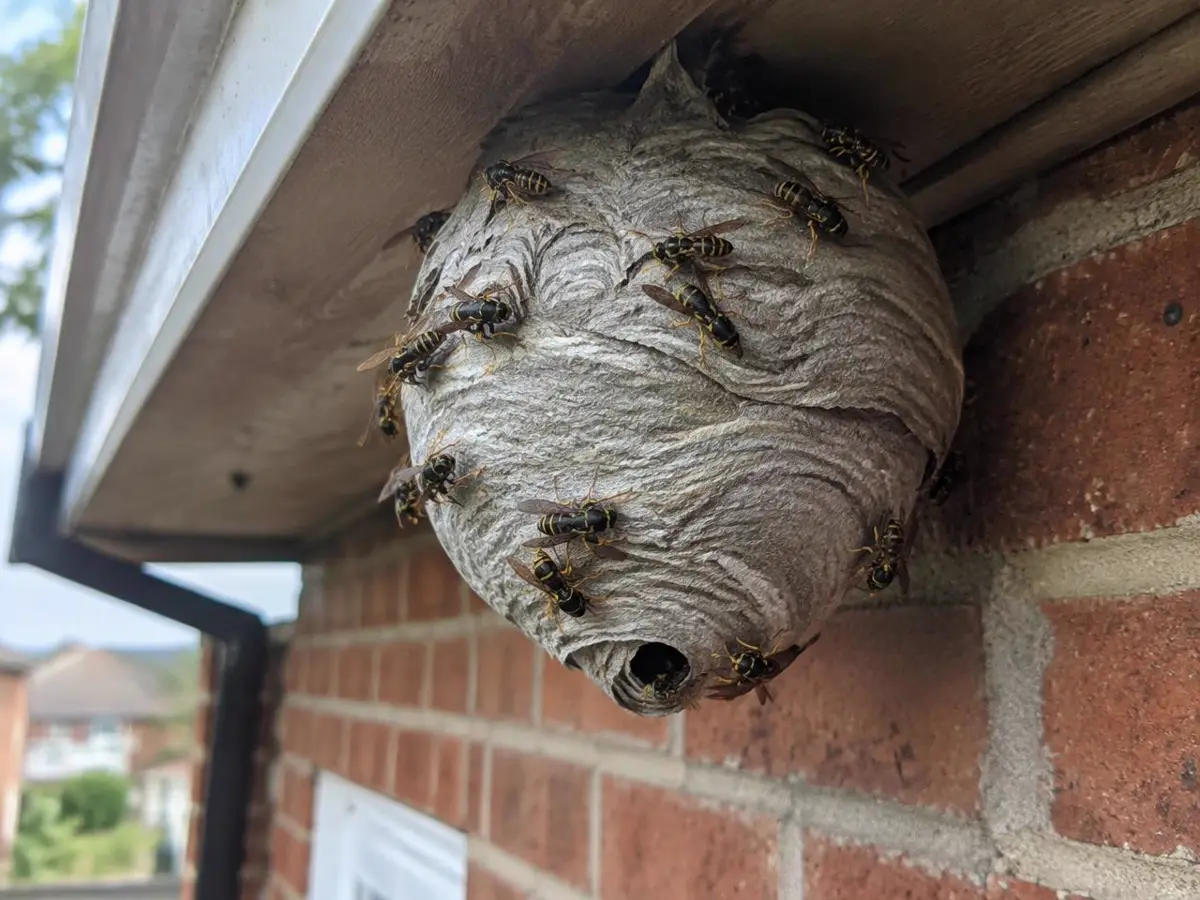
Should I treat a wasp nest myself?
Do not block an active entrance or disturb a concealed nest. A roof void, wall cavity or ground nest can be difficult to reach and leaves little room to retreat. Keep people away and discuss professional treatment when the nest creates a sting risk, especially beside a doorway or an occupied room.
Start with the problem, not a spray
If you want to get rid of wasps, first distinguish a nest from insects visiting food, flowers or a bin. A few wasps over a patio do not establish that a colony is on your property. Watch from well away for a repeated flight line to one opening without following it into a hedge or enclosed space.
Buying a treatment before identifying the insects can lead to unnecessary harm and leave the real problem unresolved. Bees, hoverflies and wasps can be confused at a glance. We never treat bees; a local beekeeper or BBKA swarm collector can advise about honeybee swarms. Suspected Asian hornets need reporting through the Asian Hornet Watch app to GB NNSS.
Why disturbing a nest changes the risk
Social wasps defend their colony when it is threatened. A nest that seems quiet during a brief observation is not necessarily small or safe to handle. Weather, time of day and the position of a concealed entrance affect how much activity you can see, and a paper structure can conceal insects beyond your view.
Spraying, striking or moving the nest brings you close to the source of defensive behaviour. Shop-bought products do not remove the need for safe access, correct identification and careful label compliance. A visible early-season nest is not an automatic invitation to tackle it yourself, especially where moving away quickly would be difficult.
Situations where professional assessment matters
Do not attempt DIY treatment of a concealed nest in a wall, roof void or ground cavity. You cannot reliably see the colony or predict where disturbed insects may emerge. A nest near a bedroom, shared doorway or public path also creates risks for people who have not chosen to take part in your attempt.
Known sting allergy, young children, restricted mobility and pets all change the practical decision. Keep these people and animals away and ask for advice. Never test whether a nest is active by tapping it, lifting roof materials or inserting a tool into its entrance. The information gained is not worth bringing yourself into the flight line.
Methods to avoid altogether
Do not use fire, petrol, boiling water or improvised chemical mixtures on a wasp nest. These methods can injure people, damage the property and provoke the colony without resolving the problem. A vacuum cleaner or hose is not a substitute for a planned treatment, and striking a nest risks releasing insects around you.
Do not block an active entrance with foam, mortar or tape. Wasps in a concealed space may seek another route, including into occupied rooms. Sealing gaps is a prevention task for an appropriate later stage, not an emergency way to trap a live colony. Avoid interfering with the opening while waiting for professional advice.
What professional wasp control involves
Professional assessment considers the insect, the route into the nest and the people using the surrounding area. It should not assume that every flying insect needs treatment. The aim is to deal with a confirmed active colony where it poses a practical risk, while giving clear instructions about access and what to expect afterwards.
Our nests are treated from the ground with a telescopic pole. We give one fixed price on the phone, with no call-out fee and a free revisit. Describe awkward access, multiple areas of activity and any indoor wasps before booking. Do not create access yourself by removing panels, cutting vegetation around the entrance or opening a roof void.
Middlesex properties need a practical plan
On a 1930s semi, an entry point under the eaves may look accessible from an upstairs window while remaining unsafe to approach. In a Victorian terrace, a small rear garden and shared boundaries can put neighbours close to activity. Explain these arrangements so that the immediate working area can be considered before treatment.
Gardens adjoining parks often have ordinary foraging traffic, which should not be confused with a nest in the house. Keep food covered and bin lids closed while observing from a safe position. In communal gardens, tell the person responsible for the property rather than trying a private treatment that could expose other residents without warning.
Stings, allergy and emergency action
If a wasp stings you, leave the area calmly before dealing with the skin. Wash with soap and water and use a cold compress wrapped in cloth. A pharmacist can advise on suitable relief for pain or itching. A previous mild reaction does not guarantee that every future sting will be mild.
Call 999 for breathing difficulty, swelling of the mouth or throat, sudden faintness or collapse after a sting. Use a prescribed adrenaline auto-injector immediately as directed and follow the emergency call handler’s advice. Seek urgent NHS 111 advice for a sting in the mouth or throat, near the eye, multiple stings or symptoms that are worsening, even without obvious anaphylaxis.
When leaving it alone is the better option
Not every nest needs treatment. If a colony is away from doors, paths and regular activity, and its surroundings can remain undisturbed, monitoring from a distance may be reasonable. Consider who might unexpectedly enter that space, including gardeners, children and visitors, rather than relying only on your own ability to avoid it.
Social wasp colonies are seasonal, although their decline depends on weather and species rather than a guaranteed calendar date. New queens overwinter elsewhere; the old nest is not reused. If you choose to leave a nest, review the decision when activity or access changes. Call for advice if the route becomes busy, insects enter rooms or safe separation is no longer practical.
Frequently asked questions
Is a small nest safe to remove myself?
Size alone does not establish safety. Identification, access, allergy and the possibility of disturbing the colony all matter.
Can I seal the entrance tonight?
No. Leave an active entrance open and keep people away. Blocking it can divert insects into other parts of the building.
Are garden wasps evidence of a nest?
Not necessarily. They may be foraging for food or water from a colony elsewhere.
Can you help if DIY has failed?
Call for advice and explain exactly what product or method was used. Do not add more treatments while waiting.