
Nest location guide
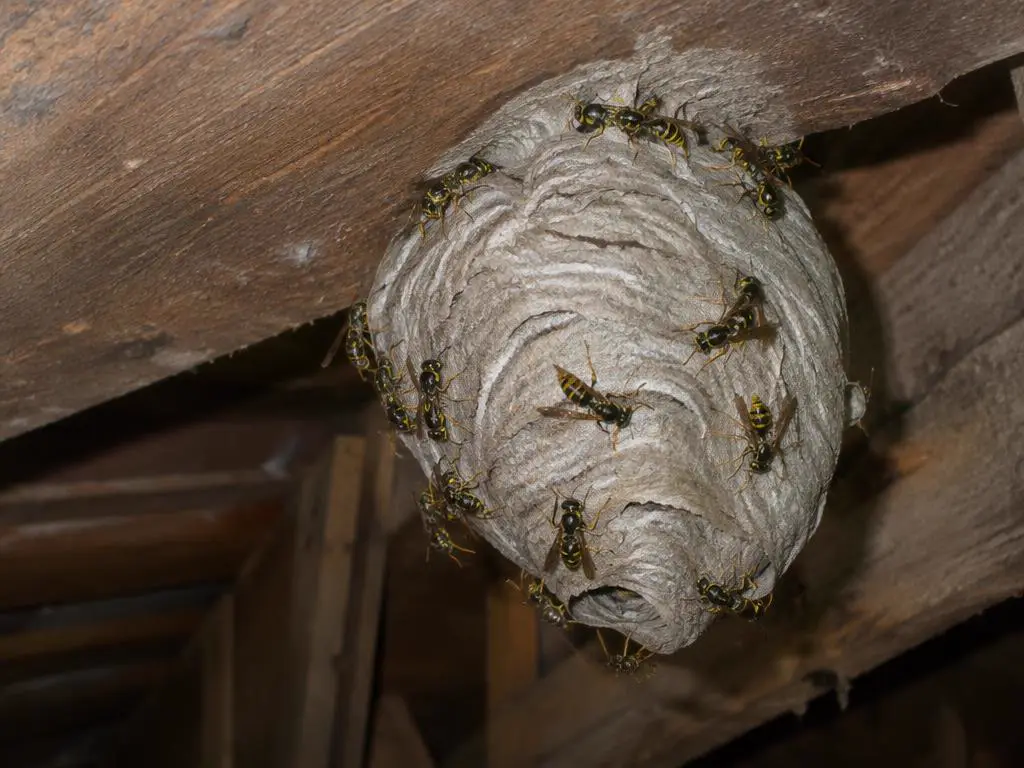
A wasp nest in the loft
A loft nest often hangs from a rafter or sits behind insulation, while its entrance is outside under the roof tiles. Leave the hatch closed: we can usually treat the colony through its external flight entrance without clearing your loft.
One message and a technician confirms the price and a time to visit.
What should I do about a nest in the loft?
- Do not move insulation or stored boxes beside activity
- Keep the loft hatch closed
- Do not spray into the roof space or seal the roof entrance
How is this nest treated?
We trace the flight line to the roof opening, then apply insecticidal dust at that entrance using a telescopic lance from ground level. Wasps carry the treatment into the hidden loft nest.
How long does treatment take to work?
Loft colonies usually quieten within 2–3 hours after treatment and are fully inactive within 24 hours. Keep the hatch closed during that period.
How wasps find their way into a loft
A queen can enter through a slipped tile, a gap at the roof verge or an open soffit joint in spring. She builds the first paper cells on a sheltered surface; workers later enlarge the nest around rafters, felt or insulation. The paper structure can be some distance from the opening you see outside.
An occupied loft is not necessarily a dirty or neglected loft. Dry shelter and a usable roof gap are enough, and a recently converted roof can still have an accessible void beside the finished room.
Roof-edge traffic and noises above the ceiling
Watch the roof from the garden for insects returning to one precise gap. Repeated arrivals and departures identify an entrance much better than occasional wasps crossing above the house. Tell us which elevation is affected and whether the opening is near a bedroom window.
Buzzing or scratching above a ceiling deserves attention, particularly when it accompanies roof-edge traffic. Do not walk across ceiling joists or pull insulation aside to confirm it: the colony may be hidden immediately underneath.
Why a loft is a poor place for DIY treatment
Loose insulation, exposed joists and dim light leave little room to retreat if a nest is disturbed. An aerosol aimed at the visible paper shell can miss the colony inside and bring defensive wasps towards the hatch.
Keep electricians, roofers and anyone fetching stored belongings out of the affected roof space until treatment has worked. If wasps are entering the room below, close that room off and mention the indoor activity when booking.
Treating the nest without opening the roof
Our technician identifies the insect, finds its external access route and checks the ground position beneath it. A telescopic dust lance places the treatment into the active roof gap; returning workers distribute it through the nest. There is normally no need to remove tiles or expose the paper structure.
A roof entrance hidden behind an extension needs an access assessment before treatment. If the insects prove to be bees, we leave them untreated and direct you to beekeeper advice instead.
When the loft is safe to use again
Expect the colony to go quiet in 2–3 hours, with full inactivity within 24 hours of treatment. Returning foragers can still arrive during the first few hours, so leave both the hatch and the outside entrance undisturbed.
Check the external flight line from a safe distance the following day before planning a storage trip. Continuing traffic after 24 hours needs a call to us for the included free revisit, not a second attempt with a household spray.
Leaving the old nest and protecting the roof next spring
An inactive loft nest can usually stay where it is: next year’s queen does not reuse its paper cells. Physical removal is useful only when the nest obstructs maintenance or access, and should wait until the colony is confirmed inactive.
Have slipped tiles and damaged roof-edge joints repaired afterwards. Ask the roofer to retain the designed ventilation, then make a visual roof-edge check in spring rather than routinely disturbing the insulation.
Frequently asked questions
Should I empty my loft before you arrive?
Leave stored belongings where they are; external treatment normally avoids entering the roof space at all.
Can a loft nest damage the ceiling?
Wasps can chew material around a confined nest, and indoor insects or a changing ceiling surface need prompt assessment. Do not poke or press the affected patch.
Will the treatment require roof tiles to be lifted?
A clear flight entrance is usually enough to treat a concealed colony from below, so lifting tiles is not the starting point.
Treatment and local advice
How nest treatment works · Wasp and hornet guides · Find your town
Price
£129 fixed price, wasps or hornets. No call-out fee. Free revisit if required. See how pricing works.
Other nest locations
Speak to a technician, not a call centre.
Fixed price on the phone. No call-out fee. Free revisit if the nest is still active.