
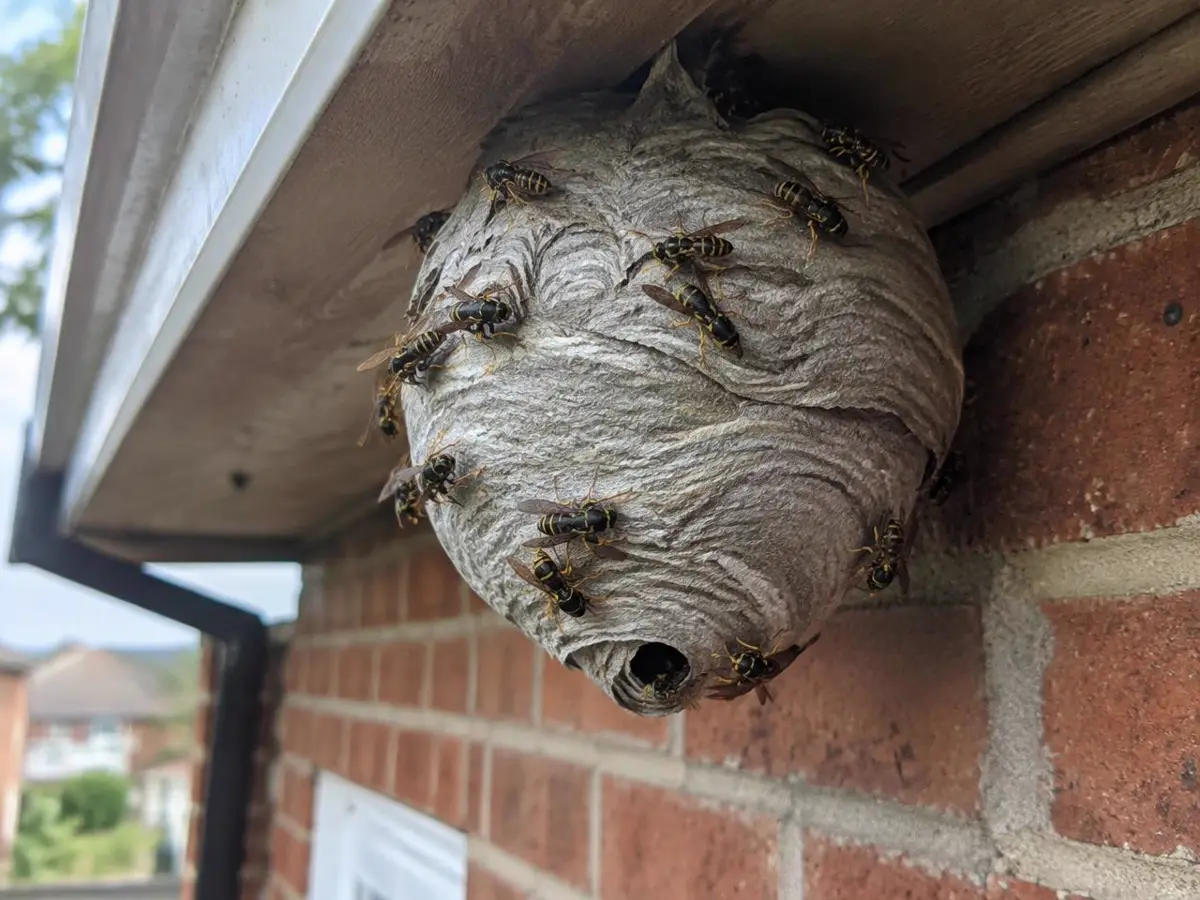
What should a business do about an active wasp nest?
Keep staff and visitors away from the entrance and isolate the affected route where possible. Tell the technician about loading areas, public access and operating times before booking. Treatment is arranged in daylight, with reopening and aftercare advice based on the actual nest location rather than a blanket promise that every business can remain open.
Start with exposure and responsibility
Commercial wasp control is about the people using a site as well as the location of a colony. A nest beside a staff-only storage area creates a different risk from one beside a school entrance, care-home seating area or pub garden. Establish who is responsible for the premises and who can authorise assessment before anyone attempts treatment.
Identify the affected route and whether people can avoid it without entering another unsafe area. A few wasps at outdoor tables may be foraging rather than nesting on site. Clear observations help distinguish a colony that needs attention from a wider food and waste-management issue. Do not ask staff to search cavities or disturb a suspected nest to confirm it.
Signs staff can report safely
Ask staff to report repeated flights into one opening, regular indoor sightings or activity concentrated beside a doorway or ground hole. A simple description of the location is more useful than an attempt to count every insect. An outside photograph may help if it can be taken without approaching the flight line.
Do not send someone into a roof space, store cupboard corner or dense hedge to obtain a closer view. Scratching sounds alone do not identify wasps, and a paper nest can be old and inactive. Record what has actually been seen, whether it affects occupied areas and any products already used, so that an assessment begins with facts rather than an assumed diagnosis.
Schools, nurseries and care settings
Children and people who need assistance may not reliably recognise or avoid a nest entrance. Keep affected areas out of use where practical and tell the staff responsible for supervision. Consider arrival routes, outdoor play, seating and access needed for support rather than placing a warning only where adults are likely to notice it.
Known sting allergy should be managed through the setting’s existing medical arrangements. Do not ask a person with an allergy to inspect the nest or rely on their medication as protection from avoidable exposure. Tell the pest controller about the use of the area and any access constraints. A quieter time can help with planning, but the safe working arrangements need agreement rather than assumption.
Restaurants, pub gardens and food waste
Outdoor food, sweet drinks and bins can attract wasps from surrounding colonies. Clear tables promptly, keep waste containers closed and clean spills where it is safe to do so. These measures reduce attractants but do not treat an established nest, so combine housekeeping with observation of any repeated entry point.
Do not place improvised attractants beside seating or tell customers that nest treatment will eliminate every visiting wasp. Keep food preparation and public access arrangements clear when discussing a visit. If a nest is near a service door or bin store, consider an alternative route while awaiting advice. Never block the nest entrance as a shortcut to keeping insects away from customers.
Warehouses, landlords and managed buildings
A concealed nest near a loading point, roof edge or communal doorway may expose staff, residents and contractors differently. Tell the site manager or managing agent and share the entry location with anyone planning repairs, cleaning or grounds work. Do not allow routine maintenance to continue through a suspected flight line while responsibility is being discussed.
In rented and multi-occupied premises, clarify access to the affected area and who will communicate the advice afterwards. Several visible openings do not necessarily mean several nests, while activity in separate parts of the site deserves explanation. Ask residents or staff for safe observations rather than requesting that they open roof hatches or remove panels to map the colony.
Middlesex premises and the treatment approach
Local sites range from businesses in Victorian terraces to care settings in converted houses and workplaces adjoining parks. A 1930s semi used as a managed property can have the same sheltered roof gaps as a private home. Narrow passages, neighbouring gardens and public routes make the surrounding use as important as the building itself.
We are based in Ruislip, Middlesex, and treat nests from the ground with a telescopic pole. Explain gates, obstructions, busy periods and indoor activity when calling. We give one fixed price on the phone, with no call-out fee and a free revisit. Keep staff and visitors away from the immediate area and follow the location-specific instructions given before reopening it.
Sting response and clear staff communication
Make sure staff know how to summon help and where the affected area is. After a sting, move the person away, wash the skin and use a cold compress wrapped in cloth. Seek urgent NHS 111 advice for stings in the mouth or throat, near the eye, multiple stings or symptoms that are worsening.
Call 999 immediately for breathing difficulty, mouth or throat swelling, faintness or collapse, and use prescribed adrenaline as directed. Follow the person’s existing medical plan and the emergency call handler’s advice. Do not delay care while identifying the insect or contacting pest control. Share any temporary access restrictions with incoming staff so that the next shift does not unknowingly disturb the same area.
Aftercare, identification and proportionate control
Follow the instructions given after treatment and do not seal the entrance or handle the nest until advised it is appropriate. If activity continues, contact us about the free revisit and describe where it occurs. Keep food and waste routines in place because foraging insects from elsewhere can still visit the premises.
Not every colony requires treatment if it can remain undisturbed away from people. We never treat bees; local beekeepers or BBKA swarm collectors can advise on suitable bee help. Suspected Asian hornets must be reported to GB NNSS through the Asian Hornet Watch app and not treated. Build these distinctions into staff reporting so a generic report of “wasps” does not lead to the wrong response.
Frequently asked questions
Do table-visiting wasps mean there is a nest on site?
No. They may be foraging from elsewhere. Look for a repeated entry point and manage food and waste attractants.
What should staff do while waiting?
Keep people away from the affected area, postpone nearby maintenance and leave the entrance unobstructed.
What information helps with booking?
Describe the entry point, public access, indoor sightings, obstructions, site use and any known allergy concerns.
What if activity continues after treatment?
Follow the aftercare instructions and contact us about the free revisit, describing where activity remains.