
Nest locations
Where wasp nests are found
Every nest spot behaves differently. Choose where you have seen wasps going in and out for signs, risks, what to avoid and how we treat it.
One message and a technician confirms the price and a time to visit.
Not sure what you have? Read the signs of a wasp nest, see how treatment works or check our fixed pricing.
Loft
A loft nest often hangs from a rafter or sits behind insulation, while its entrance is outside under the roof tiles. Leave the hatch closed: we can usually treat the colony through its external flight entrance without clearing your loft.
Eaves and soffits
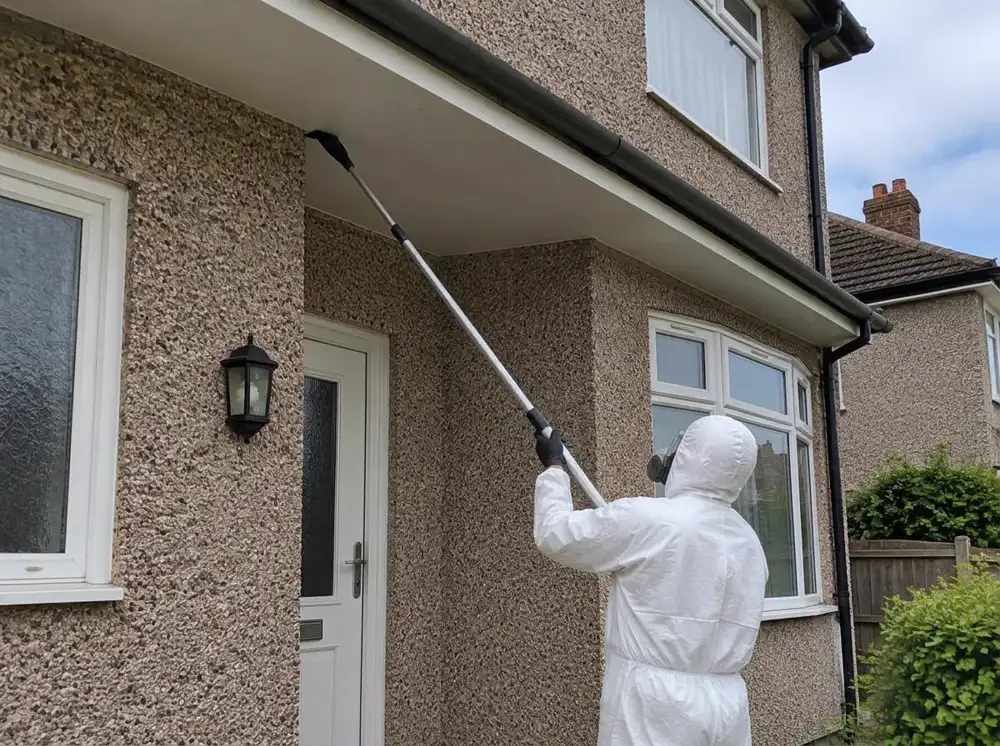
Wasps repeatedly entering a fascia corner or the soffit-to-wall junction are using a sheltered roof void. We target that opening from the ground, not the middle of the board, and leave the roof trim intact.
Wall cavity
A narrow mortar gap or an opening beside a pipe can lead to a wasp nest inside the wall. Keep the brickwork intact and the entrance open: blocking it can send the insects towards the inside of the house.
Air brick
Wasps flying through an air brick usually have a nest in the cavity or underfloor space behind it. The vent must stay open, both for the insects’ treatment route and for the building’s ventilation.
Chimney
Wasps can occupy a disused flue or a gap around a chimney stack. Do not light a fire to drive them out: we assess the external entrance, its reach and the use of the flue before deciding on treatment.
Shed and garage
A quiet shed roof or garage corner gives wasps somewhere to hang a paper nest. Stop fetching tools once you notice a colony: moving a door, stacked boards or stored furniture can disturb it at close range.
Garden and underground
A regular stream of wasps entering one soil hole can indicate a nest in an old burrow. Stop mowing or digging nearby, keep dogs away and do not flood the opening; bumblebees must be ruled out first.
Hedges and trees
A papery nest can be hidden inside a hedge, while European hornets may occupy a hollow trunk. Put hedge cutting on hold if insects keep entering one spot; do not part branches or probe the cavity.
Conservatory and bay roofs
Wasps can enter beneath bay-roof flashing or through a conservatory trim joint and nest in the enclosed space. Leave glazing bars and roof panels untouched: we follow the external entrance rather than dismantling the roof.
Speak to a technician, not a call centre.
Fixed price on the phone. No call-out fee. Free revisit if the nest is still active.