
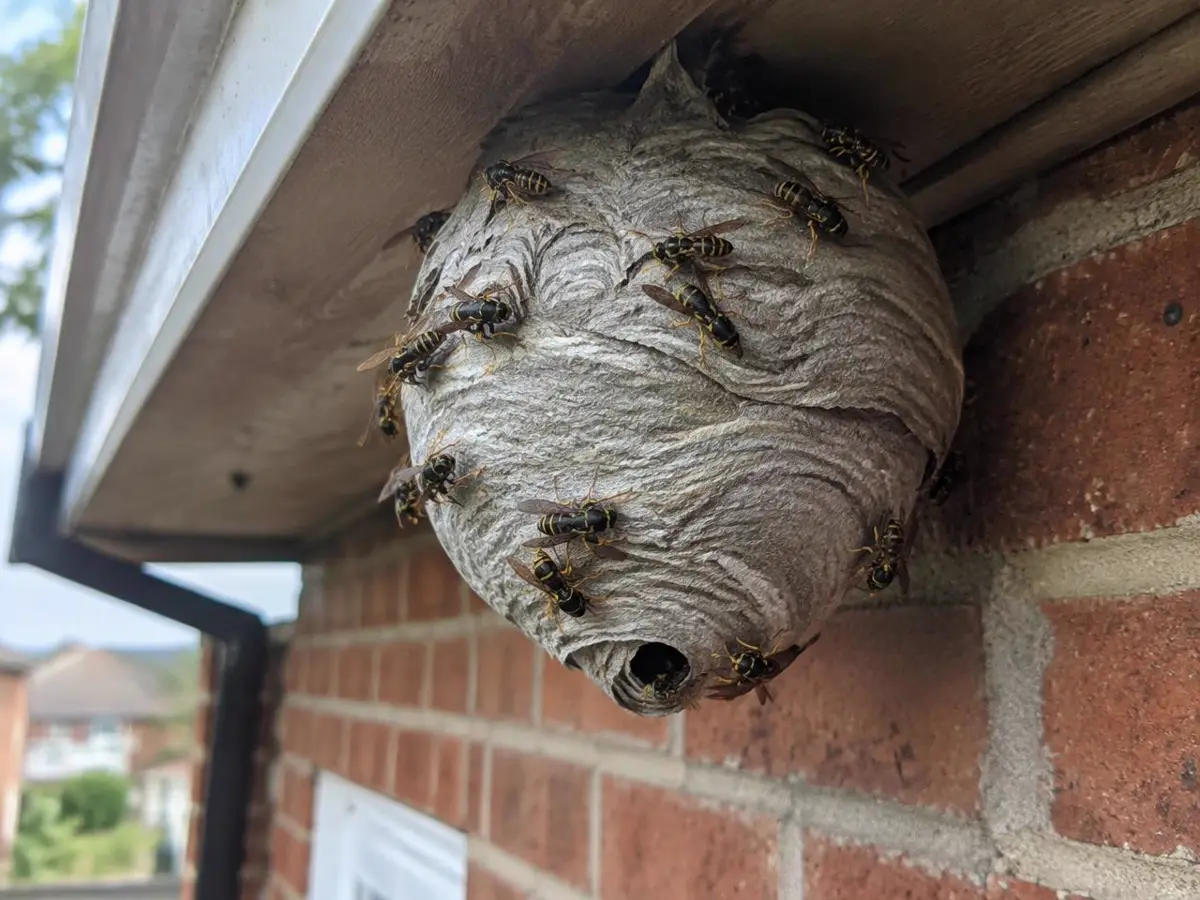
How can I reduce the chance of another wasp nest?
Repair accessible building gaps only after any colony is confirmed inactive, and preserve designed roof and wall ventilation. In spring, watch for repeated traffic to an opening. Cover food and drinks and keep bin lids closed to reduce foraging activity; these measures cannot guarantee a wasp-free garden.
Reduce opportunities, not every insect
No garden or building can be guaranteed wasp-free. Wasps travel to forage and can appear even where there is no nest on the property. Prevention is about reducing accessible nesting opportunities where practical and limiting close encounters around food, waste and everyday routes, rather than eliminating insects from the wider environment.
Start by distinguishing a maintenance task from an active nest problem. A quiet external gap may be suitable for repair at the right time; a gap with repeated wasp traffic must not simply be sealed. Blocking a live entrance can divert insects into another route, including occupied rooms, and make an otherwise external problem harder to manage.
Plan building maintenance for an appropriate time
Once a nest is confirmed inactive, inspect ordinary building defects as part of routine maintenance. Gaps around damaged fascia, soffits or brickwork may offer access to sheltered spaces. Repairs can reduce opportunities, although another suitable site may still exist elsewhere and no maintenance programme guarantees that a queen will not choose the building again.
Use suitable tradespeople for repairs beyond safe ground access and preserve required ventilation. Do not fill air bricks or roof ventilation indiscriminately. An old paper nest does not have to be removed merely to stop it being reused: social wasps build new nests. The useful question is whether the building has a defect worth repairing, not whether every trace of paper can be extracted.
Observe in spring without interfering
In spring, queens search for sites and begin small nests before workers emerge. A ground-level visual check around sheds and visible roof edges can reveal repeated visits to one place. This is observation, not a reason to poke into corners, dismantle panels or attempt to knock down a structure that looks small.
If you notice a queen or a little paper nest, consider the location and obtain advice if it conflicts with access. Do not assume that a single large wasp means a colony is established. Bees may also be active around buildings in spring, and we never treat bees. Local beekeepers or BBKA swarm collectors can advise about appropriate help for honeybee swarms.
Manage food, drinks and waste
Keep sweet drinks covered outdoors and check containers before drinking. Clear spills and food scraps promptly, and close bin lids rather than leaving packaging exposed. These steps can reduce the attraction of an eating area, but they do not remove a nest that is already active nearby.
Fallen fruit and sticky residue can draw foraging wasps into gardens. Clear them when it is safe, avoiding areas where a ground nest is suspected. Do not swat at insects around a table or place attractants beside doorways in an attempt to draw them away. If activity repeatedly converges on one building opening, investigate through safe observation rather than assuming better bin hygiene alone will resolve it.
Gardens, sheds and routine work
Before hedge cutting, mowing close to old holes or clearing a rarely used shed, look for repeated insect traffic from a safe position. Ground nests and concealed colonies can be disturbed by ordinary maintenance. If activity is concentrated at one point, postpone the work and tell anyone else who might use the equipment or enter the area.
Keep shed doors and windows in sound condition where practical without sealing an active nest inside. Do not remove stored items around a suspected colony to make it easier to see. A garden can still support flowers and useful insects while people avoid a specific flight line. A remote nest may be left if safe separation can be maintained throughout its active season.
Middlesex housing and shared responsibilities
Middlesex has many 1930s semis with roof edges, extensions and side passages, alongside Victorian terraces with compact gardens and shared boundaries. A maintenance plan should reflect these details. An entrance over a rarely used corner presents a different issue from one beside a neighbour’s route or a communal bin store.
Gardens near parks and mature trees will have visiting insects irrespective of house repairs. In rented or managed properties, report repeated entry points to the landlord or managing agent rather than altering the building yourself. Share useful observations, including when and where activity occurs, without encouraging neighbours to approach the opening. Agree who is responsible for arranging assessment before routine work goes ahead.
Know when prevention is no longer enough
Repeated entry into a roof or wall, wasps appearing regularly in a room or a nest beside an unavoidable doorway calls for assessment. Do not respond by filling the hole, using improvised chemicals or striking the nest. We are based in Ruislip, Middlesex, and treat nests from the ground with a telescopic pole.
Our approach is one fixed price given on the phone, with no call-out fee and a free revisit. Mention access, indoor activity and any known sting allergy when calling. Prevention work can then be considered at an appropriate stage after the active problem is addressed, rather than confusing building repairs with treatment or attempting to trap the colony within a void.
Include identification and sting safety in the plan
Keep children, pets and visitors away from a suspected nest and explain the location to gardeners or other contractors. Someone with a known sting allergy should not inspect it. After a sting, move away, wash the skin and apply a wrapped cold compress. Breathing difficulty, mouth or throat swelling, faintness or collapse needs 999 immediately and prescribed adrenaline as directed.
A suspected Asian hornet should be reported to GB NNSS through the Asian Hornet Watch app, not treated or trapped as a prevention measure. Bees need different advice and we never treat them. Safe prevention depends on recognising these limits: maintain the property sensibly, reduce food attractants and seek the correct help rather than acting on every striped insect.
Frequently asked questions
Can I stop every wasp visiting my garden?
No. Wasps forage over surrounding areas. Covered food, clean tables and closed bins can reduce close encounters.
Should I seal the hole as soon as I see wasps?
No. Do not block an active entrance. Seek advice and plan repairs only when appropriate.
Does removing an old nest prevent another?
Not reliably. Old nests are not reused, but another queen may choose a different site in the same building.
Are spring inspections safe?
Observe visually from safe ground positions. Do not open voids, disturb small nests or approach busy entrances.