
What should I do if I see a suspected Asian hornet?
Keep your distance and report the sighting to GB NNSS through the Asian Hornet Watch app. Supply a photograph only if it can be taken safely. Do not approach, disturb or attempt to treat a suspected nest, and do not book it as an ordinary European hornet treatment.
Report a suspicion rather than arranging treatment
The yellow-legged Asian hornet is an invasive non-native species that preys on honeybees and other insects. A suspected sighting needs an official reporting response, not a routine booking to get rid of wasps. Report it to the GB Non-Native Species Secretariat, known as GB NNSS, through the Asian Hornet Watch app.
Do not attempt to treat a suspected Asian hornet or its nest. You do not need to confirm the species yourself before submitting a genuine suspicion with the evidence you can safely provide. Equally, a large flying insect is not automatically an Asian hornet: native hornets, queen wasps and other insects can be mistaken for it.
The main identification features
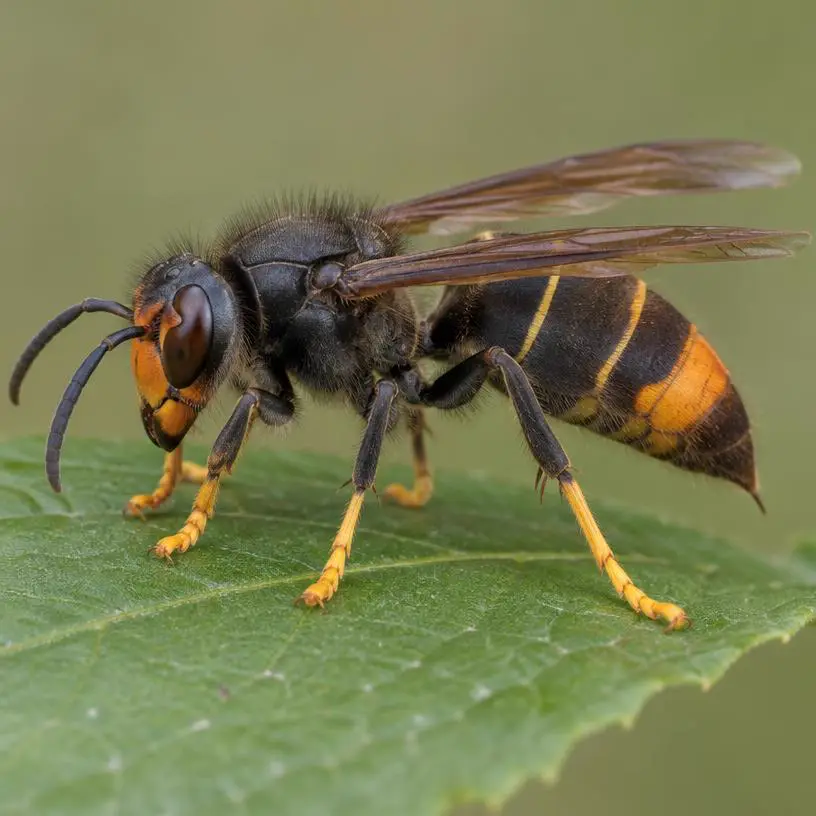
The yellow-legged Asian hornet is predominantly dark, with an orange face, yellow tips to its legs and a broad orange band towards the rear of the abdomen. Its overall impression is darker than the native European hornet. Use several features together rather than deciding from one stripe or an impression of unusual size.
A safe photograph showing the whole insect is useful for assessment, but it is not worth approaching a nest or following a hornet through vegetation to obtain one. Note uncertainty where the view was brief. Do not handle an insect, alive or apparently dead, simply to inspect its legs more closely. Reporting what you genuinely saw is preferable to creating a risk for a better picture.
European hornets and other lookalikes
European hornets usually show reddish-brown areas on the head and thorax, with a more extensively yellow abdomen carrying dark markings. Common social wasps are also yellow and black, while some hoverflies and other insects can look hornet-like at a glance. Lighting, viewing angle and movement can all affect the impression of colour.
An insect at an evening light may be a native European hornet, which can fly in low light, but behaviour alone cannot settle identification. Avoid assuming that dark colour, size or a visit to a beehive proves the species. Submit safely available evidence through the reporting route and leave assessment to those handling the report rather than trying to capture a specimen.
How to make a useful report
Use the Asian Hornet Watch app to report the sighting to GB NNSS. Provide the location as accurately as you can, the time or date of observation and any photograph obtained without approaching. Describe whether you saw a single insect, repeated visits or something that appeared to be a nest.
You do not need to search the surrounding area for more evidence before reporting. If you cannot safely photograph the insect, do not chase it. Keep a record of what you observed so that you can answer any follow-up questions accurately. Follow the official instructions associated with your report rather than an informal social-media recommendation to trap, kill or treat the insects yourself.
What to do near a suspected nest
Keep well away and prevent children, pets and other people from approaching. Do not shake branches, cut vegetation, open building cavities or use a spray to test what is inside. A nest may be concealed, and disturbance can expose people to defending insects without helping identification or the official response.
If the site is on shared land or near a public route, inform the responsible owner or manager as well as making the report. Describe the location without encouraging others to visit it for photographs. Do not place yourself near the entrance to guard it. Any temporary warning or access arrangement should be made from a safe position without disturbing the suspected colony.
Middlesex homes, gardens and parks
The same reporting advice applies whether a suspected hornet is seen in a Ruislip garden, beside a Middlesex park or around a house. A 1930s semi, a Victorian terrace and a garden shed can all bring people close to flying insects, but the property type does not establish what species is present.
A nest-like shape high in a tree is not enough for certain identification either. Stay on ordinary safe ground and do not climb, lean from windows or send someone into vegetation to investigate. In communal gardens, schools and other managed settings, give staff or the managing agent a clear account so that routine grounds work does not accidentally disturb the area while advice is sought.
Stings and allergy: urgent care comes first
If somebody is stung, move away from the area before giving first aid. Wash the skin and apply a cold compress wrapped in cloth. Seek urgent NHS 111 advice for a sting in the mouth or throat, near the eye, multiple stings or worsening symptoms. A suspected species identification should not delay a medical call.
Call 999 immediately for breathing difficulty, swelling of the mouth or throat, sudden faintness or collapse. Use a prescribed adrenaline auto-injector as directed if available and follow the emergency call handler’s instructions. Someone with a known sting allergy should not help investigate a suspected nest. A previous mild sting reaction does not rule out a serious reaction on another occasion.
How this differs from ordinary wasp control
For a confirmed ordinary wasp nest or a native European hornet nest, the decision is usually whether it can remain undisturbed or creates enough risk to require treatment. A remote native colony may reasonably be left alone. A suspected Asian hornet instead belongs in the GB NNSS reporting process, regardless of whether it currently inconveniences the household.
Our business is based in Ruislip, Middlesex, but we do not offer treatment of suspected Asian hornets. We also never treat bees; local beekeepers or BBKA swarm collectors are appropriate contacts for bee advice. Keep those distinctions clear when seeking help. Official reporting, safe distance and accurate observations are the useful actions, not a DIY attempt to remove the nest.
Frequently asked questions
Where should I report a suspected Asian hornet?
Report it to GB NNSS through the Asian Hornet Watch app, with location details and a photograph if safely available.
Should I kill it before reporting?
Do not approach, capture or attempt treatment. Make the report using evidence obtained from a safe position.
Is a very large wasp definitely an Asian hornet?
No. Native hornets, queen wasps and other insects can be confused with it. Several identification features matter.
Can you treat a suspected nest?
No. Keep clear and use the official GB NNSS reporting route rather than arranging routine pest-control treatment.