
Are hornet nests treated differently from wasp nests?
We treat European hornet nests at the same £129 fixed price as wasp nests, after identifying the insect and assessing access. A suspected Asian hornet must instead be reported to GB NNSS through the Asian Hornet Watch app. Never approach a nest to obtain a closer photograph.
Hornets are a kind of social wasp
The everyday distinction between wasps and hornets is useful for identification, but hornets belong to the wider wasp group. In Britain, the familiar yellow-and-black social wasps and the native European hornet can form annual colonies. They have ecological roles, including catching other insects, and a sighting does not automatically justify treatment.
The essential practical distinction is between ordinary wasp or European hornet activity and a suspected Asian hornet. Suspected Asian hornets should be reported to GB NNSS through the Asian Hornet Watch app, not treated as a routine pest-control job. In every case, identify from a safe position and do not disturb a nest to obtain evidence.
Comparing size, colour and shape
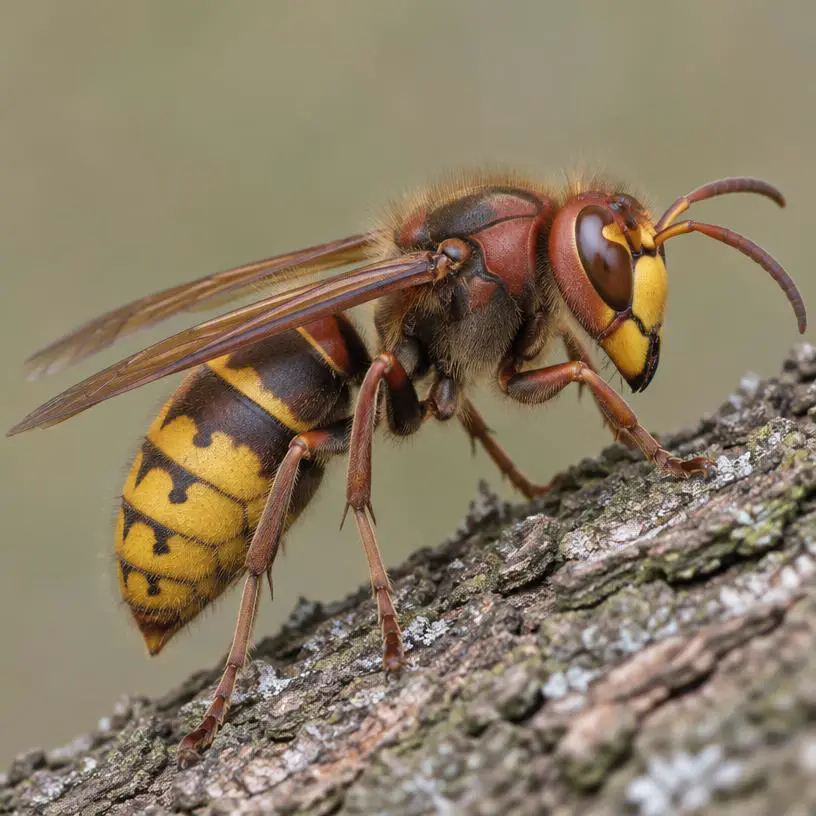
Common social wasp workers usually show bright yellow and black markings with a narrow waist. European hornets are generally larger and have reddish-brown areas on the head and thorax as well as yellow on the abdomen. Size varies between individuals and castes, so “very large” is not a sufficient identification on its own.
A queen wasp or a large bee can also look striking. Avoid relying on one quick impression, especially through glass or in poor light. A photograph of the whole insect can help if it can be taken without approaching. Do not catch it in a container or position yourself beside a nest entrance just to compare its colouring.
The Asian hornet comparison
The yellow-legged Asian hornet has a predominantly dark appearance, an orange face, a broad orange band towards the rear of the abdomen and yellow tips to its legs. The European hornet has a more extensively yellow abdomen with dark markings and more reddish-brown colouring. These are useful comparisons, not an instruction to handle either insect.
If you suspect an Asian hornet, use the Asian Hornet Watch app to report it to the GB Non-Native Species Secretariat. Include the location and a photograph if safely available. Do not follow insects to a nest, set out improvised traps or attempt treatment. Reporting allows the appropriate response to be considered without placing you or others at unnecessary risk.
Behaviour around food and light
Wasps often become noticeable around sweet drinks, bins and outdoor meals. European hornets can also be seen in gardens and are capable of flying in low light, sometimes coming towards illuminated windows. Neither a visit to a table nor attraction to a light establishes where the insect’s nest is located.
Keep food and drinks covered, remove spills and avoid swatting at passing insects. If hornets are repeatedly drawn towards a lit open window, close it where this can be done safely and consider reducing unnecessary nearby lighting. Do not interpret every close flight as an attack. At a nest, however, both wasps and hornets can respond defensively to disturbance.
Nest sites and signs that matter
Both wasps and European hornets can use sheltered cavities, and hornets are associated with places such as hollow trees and building voids. A repeated stream of insects through one opening is more informative than occasional visitors over a lawn. The nest itself may be concealed, so lack of visible paper does not exclude a colony.
Do not open a shed lining, inspect a hollow tree by hand or lift roof materials to find the structure. Watch only from a safe distance and note the entry point in relation to familiar features. Several openings do not necessarily mean several colonies, and a single visible paper nest may be old rather than currently active.
Middlesex homes, parks and gardens
Mature trees around parks and established gardens provide insect habitat, while houses offer sheltered voids. A 1930s semi with deep eaves and a Victorian terrace with roof alterations can each have potential nest sites. Neither building type is proof of infestation, and a garden visitor may have travelled from elsewhere.
The practical question is whether an active entrance conflicts with everyday use. A flight line over an unused corner may be manageable, while one beside a narrow side passage or public path may need assessment. In communal gardens, tell the responsible owner or manager. Avoid carrying out hedge cutting or tree work near any suspected colony until the situation is understood.
Sting risk and allergy precautions
Both social wasps and European hornets can sting, particularly when their nest is disturbed. The insect’s size is not a useful way to judge a person’s allergy risk. Someone with a known sting allergy should keep away from the site and follow their own clinical emergency plan rather than helping to inspect it.
For a sting, move away, wash the skin and use a wrapped cold compress. Breathing difficulty, swelling of the mouth or throat, sudden faintness or collapse requires 999 immediately and prescribed adrenaline as directed. Seek urgent NHS 111 advice for stings in the mouth or throat, near the eye, multiple stings or worsening symptoms without waiting to establish the precise species.
Choosing the correct next step
A remote wasp or European hornet nest may be left undisturbed if people can safely avoid it. If treatment is appropriate, we work from the ground with a telescopic pole. We are based in Ruislip, Middlesex, and give one fixed price on the phone, with no call-out fee and a free revisit.
Keep identification uncertainty clear when calling. We never treat bees and refer bee enquiries to local beekeepers or BBKA swarm collectors as appropriate. Suspected Asian hornets must go through the GB NNSS reporting route using the Asian Hornet Watch app; do not attempt to treat them. Choosing the right route is more important than obtaining the quickest generic “hornet removal” quote.
Frequently asked questions
Is a hornet a wasp?
Hornets belong to the wider wasp group, although their size and appearance make the everyday distinction useful.
Are all large dark insects Asian hornets?
No. Several insects can be confused with them. Report a genuine suspicion with a safe photograph through Asian Hornet Watch.
Does a hornet at a light mean a nest indoors?
Not necessarily. European hornets can fly in low light and may be attracted from outside.
Do all hornet nests need treatment?
No. A native European hornet nest that can remain undisturbed away from people may be left alone.