
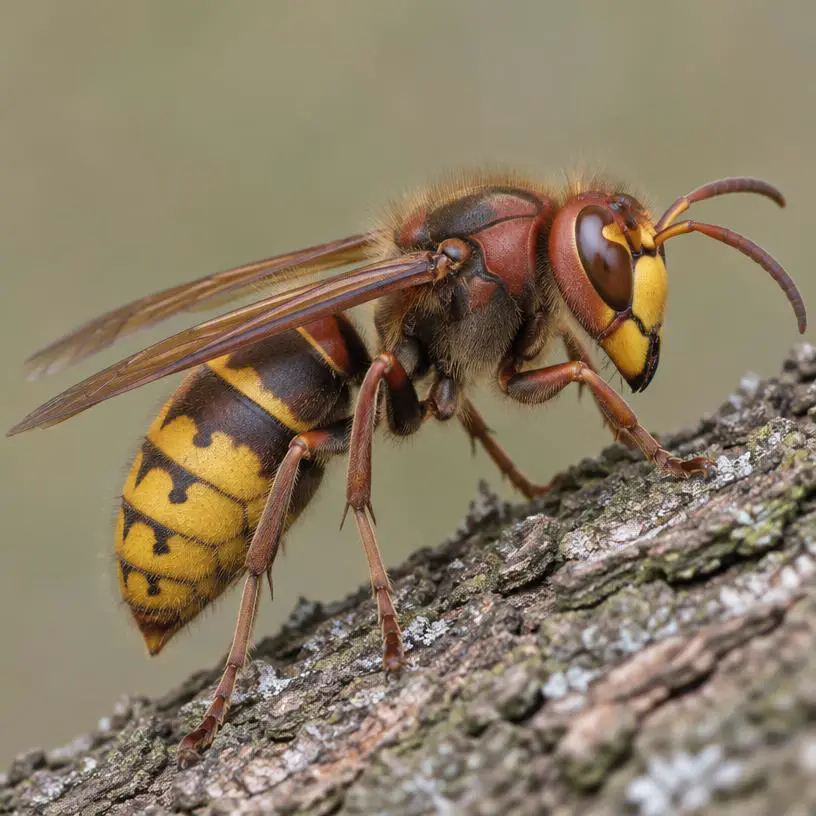
Does a European hornet nest always need treatment?
Not necessarily. European hornets are native insects and a nest away from people can sometimes be left undisturbed. A colony beside a doorway or regularly sending insects into occupied rooms needs a risk assessment. Identification comes first: a suspected Asian hornet follows the GB NNSS reporting route.
A native insect, not automatically a pest
The European hornet is native to Britain and is part of our insect fauna. Its size and audible flight can be unsettling, but a hornet passing through a garden is not in itself a reason to arrange treatment. It catches other insects and has a place in the local ecosystem alongside more familiar social wasps.
A useful response starts with identification and location. Is there one insect foraging, repeated traffic into a cavity or a nest close to a route people cannot avoid? These situations have different implications. Avoid general claims that hornets are harmless or that every hornet is unusually dangerous: a colony can defend its nest and stings can cause serious allergic reactions.
Recognising a European hornet safely
European hornets are generally larger than common social wasp workers. They have reddish-brown areas on the head and thorax and a yellow abdomen with dark markings. Individuals vary in size, and a brief glimpse is not always enough to separate a hornet from a queen wasp or another large insect.
Observe without approaching the flight line. A photograph can be useful if taken from somewhere already safe, but do not handle the insect or try to expose its nest. A description of size alone is weak evidence. Include colour and the type of activity you saw, while making clear if poor light or a fleeting view made identification uncertain.
Where European hornets build nests
European hornets use sheltered spaces such as hollow trees and building cavities, and may nest in outbuildings or roof voids. The papery nest can remain hidden even where workers are conspicuous outside. A repeated entry route is therefore more useful than trying to see the entire structure.
Never put a hand or tool into a tree cavity or pull back shed lining to confirm the nest. Disturbance can expose you to defending workers. If work is planned around an occupied tree or building feature, stop and tell the responsible person. A professional assessment should consider both the colony and the people who might inadvertently disturb it during ordinary maintenance.
Low-light activity and indoor visitors
European hornets can fly in low light and may be attracted to artificial lighting. A hornet at a lit window in the evening does not prove that it lives in the roof above you. Where practical, keep the window closed and reduce unnecessary lighting near open doors instead of trying to strike the insect.
Repeated hornets inside the same room deserve closer attention from a safe distance. Note whether they appear from a particular ceiling edge or building gap and seek advice. Do not spray into light fittings, dismantle panels or seal an outside entrance to stop them. If a concealed colony is present, closing one route may redirect activity somewhere less manageable.
The colony’s annual life cycle
Like other familiar social wasps, European hornets have an annual colony cycle. A queen establishes a nest in spring, workers take over foraging and nest duties, and the colony later produces males and new queens. Mated new queens seek winter shelter away from the old colony as that colony declines.
The old paper nest is not reused the following year. Its presence in a loft does not by itself establish an active hornet problem, and removing the paper will not guarantee that another sheltered site is never chosen. Timing varies with weather, so do not assume a nest is empty simply because autumn has arrived or activity is quiet during a cold morning.
Middlesex settings and deciding to leave it
Mature trees in parks and established gardens can provide suitable habitat. Around Middlesex homes, both 1930s semis and Victorian terraces can have sheltered building voids. Consider whether the actual entrance is away from normal activity or beside a doorway, narrow passage, outdoor seating area or frequently used shed.
If separation is practical and no nearby work will disturb the colony, leaving a native hornet nest alone can be reasonable. Keep children and pets away and tell anyone who maintains the garden. In communal or public spaces, report the location to the responsible landowner rather than taking action yourself. Review the decision if access changes or insects start entering occupied rooms.
When treatment and medical advice matter
Seek professional assessment where an active nest exposes people to unavoidable close contact, especially if someone has a known sting allergy. We treat European hornet nests where they pose a risk to people, working from the ground with a telescopic pole. Based in Ruislip, Middlesex, we give one fixed price on the phone, with no call-out fee and a free revisit.
After a sting, leave the area and provide ordinary first aid. Call 999 for breathing difficulty, mouth or throat swelling, faintness or collapse, and use a prescribed adrenaline auto-injector as directed. Do not wait for species confirmation before getting medical help. Tell the pest controller about repeated indoor sightings and any treatment already attempted.
Do not confuse the reporting routes
A suspected Asian hornet requires reporting to GB NNSS through the Asian Hornet Watch app rather than routine treatment. It is typically darker overall, with an orange face, a broad orange band towards the rear of the abdomen and yellow leg tips. Report safely available evidence and do not attempt to locate or treat its nest.
Bees are another common source of mistaken identification. We never treat bees; contact local beekeepers or BBKA swarm collectors for appropriate bee advice. Keep uncertainty visible when describing what you have seen instead of choosing a species name from size alone. Correct identification protects people and ensures that a native hornet, a bee colony and a suspected invasive hornet receive different, appropriate responses.
Frequently asked questions
Are European hornets native?
Yes. The European hornet is native to Britain and does not automatically need treatment when seen in a garden.
Why is one visiting my window at night?
European hornets can fly in low light and may be attracted to artificial lighting.
Can I leave a nest in a tree?
Potentially, if people can keep clear and no maintenance will disturb it. Consider public access and seek advice if unsure.
Do you treat suspected Asian hornets too?
No. Report suspected Asian hornets to GB NNSS through the Asian Hornet Watch app and do not attempt treatment.