
Richmond upon Thames (Twickenham side) · TW12
Wasp & hornet nest removal in Hampton
Hampton sits between Bushy Park and the Thames, so gardens here are large, leafy and often close to the river, which wasps love.
One message and a technician confirms the price and a time to visit.
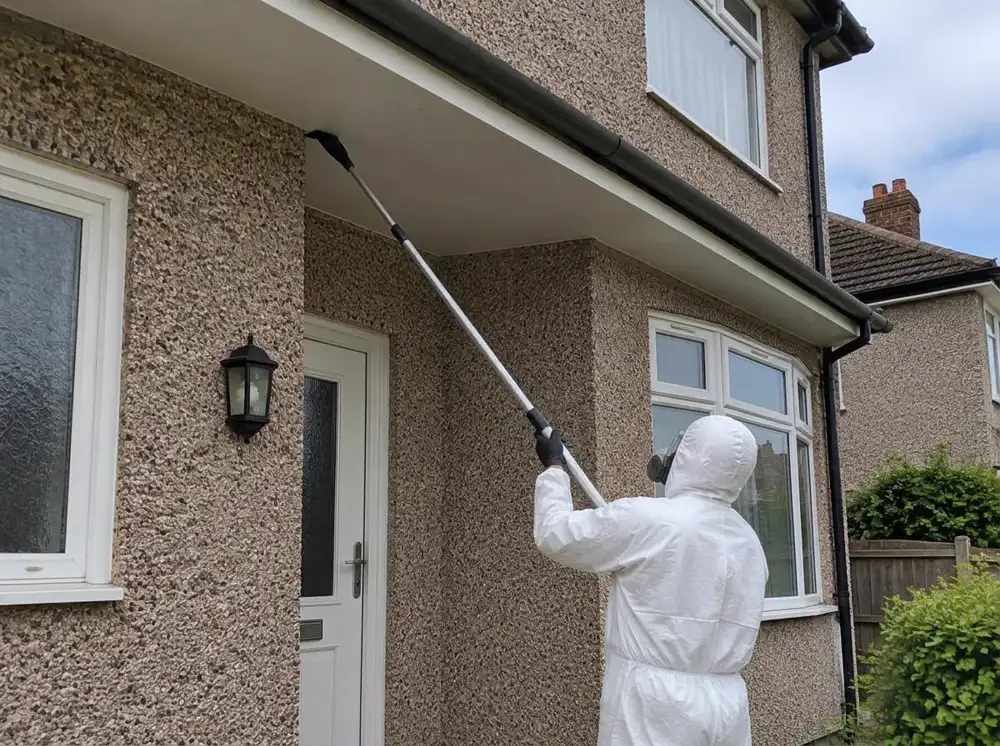
Wasp nest removal in Hampton
Wasp nest removal in Hampton often means outbuildings, mature hedges and riverside walls. Hampton sits between Bushy Park and the Thames, so gardens here are large, leafy and often close to the river — conditions wasps love. The housing runs from Victorian and Edwardian detached houses near the water to 1930s semis in Hampton Hill, with boathouses and garden stores along the bank.
Wasp nests in Hampton homes and outbuildings
Near the river the older detached houses have deep eaves, mature wisteria and climbers, and gardens with boathouses, stores and workshops. Wasps get in behind the climbers, under the eaves and into the outbuildings, and a boathouse nest is a recurring TW12 job.
In Hampton Hill the 1930s semis follow the familiar pattern of hipped roofs, soffit gaps and bay-window canopies. The gardens are long and mature, with yew and laurel hedges dense enough to hide a nest until it is well established.
Towards Hampton Court and the palace grounds there are older estate cottages and period conversions with clay tiles and deep eaves. These buildings reward a careful approach: we treat through the existing entrance and never drill or lift anything, which matters where the fabric is old or listed.
Tracing wasp nest activity in Hampton
- Boathouses and garden stores along the river, quiet and dry with water on the doorstep. — see our shed and garage nest guide
- The mature yew and laurel hedges of the larger gardens, dense enough to hide a nest until it is well established. — see our hedges and trees nest guide
- Behind wisteria and climbers on the riverside house walls, where the first sign is wasps appearing from the foliage. — see our hedges and trees nest guide
- The soffit corners of the Hampton Hill semis, the familiar interwar weak point. — see our eaves and soffits nest guide
Getting a Hampton wasp nest treated
For a Hampton boathouse nest, protecting the waterside setting matters alongside reaching the colony. We locate the active wasp entrance and apply professional insecticide dust directly into it using a telescopic lance, usually from ground level, with the application kept targeted to the nest. Passing workers carry the dust inward. Tell us about an urgent obstruction to a door or river path when enquiring about same-day visits, and we will confirm an available daylight treatment time. A nest normally quietens over 2–3 hours and becomes fully inactive within 24 hours. Children and pets remain clear of the treated structure and returning wasps until the technician's advice permits access; do not open it simply to check progress, reducing the chance of a wasp sting. Anyone trying to get rid of wasps should know that dIY spray on a closed store or dense hedge can miss the colony and introduce unnecessary product near the river. Wasp nest treatment costs £129 fixed, with no call-out fee and a free revisit when needed; European hornet nests are treated at the same price.
How a Hampton wasp nest enquiry becomes a visit
An illustrative wasp nest example: a caller near the river finds wasps streaming into the gap under a boathouse door. They call mid-morning; we confirm the fixed price and visit that afternoon. The nest inside is treated directly, with extra care to keep the product inside the nest and away from the water.
The boathouse stays shut for the rest of the day. Once nest inactivity and the aftercare conditions are confirmed it can be opened up again, and the dead nest can be swept out whenever convenient.
Arranging access to treat a Hampton wasp nest
A Hampton caller should identify whether insects enter a boathouse gap or disappear into a fixed point in a hedge. Wasp control is different from dealing with foragers visiting riverside plants. Tackling the nest yourself by cutting the hedge can uncover an active nest at close range. Include waterside access and the affected structure when you get in touch without opening the store to investigate. Keep children away from that route to reduce the chance of a sting. Treating hornets is assessed after identification; a bee swarm in the garden needs a beekeeper rather than this service. Before a Hampton visit, tell us about any doors, windows or regularly used paths beside the active nest entrance.
The riverside lanes can be narrow with limited parking, which we plan around. Larger gardens sometimes mean a walk to the far end with equipment — rarely a problem, but tell us if the nest is in a boathouse or store so we bring the right kit. The Hampton Hill streets are straightforward, with driveways and side access on most plots. For riverside properties we take extra care near the water, and if the nest is over a shared mooring or a neighbour's bank we will talk through the access we need first.
When Hampton insects are hornets or bees
With Bushy Park and Hampton Court on the doorstep, TW12 has more European hornets than most of Middlesex, and hornet nest removal here is routine for us — same visit, same fixed price as wasps. The park and riverside support plenty of bees, which we never treat; a swarm should go to a beekeeper, and we can point you towards one. Hornet nest removal in Hampton costs the same as a wasp nest, while bees fall outside pest control altogether.
Nearby areas we cover
For wasp nest treatment near Bushy Park, Hampton Court Palace, Garrick's Temple and Hampton Pool, describe the active entrance and access when you call.
Neighbouring areas: wasp nest removal in Teddington, wasp nest removal in Sunbury-on-Thames, wasp nest removal in Hanworth and wasp nest removal in Twickenham.
For the wider area, see our Richmond upon Thames (Twickenham side) page.
Hampton wasp and hornet questions
There is a nest in my boathouse. Is the treatment safe near the river?
We use professional products applied directly into the nest in small amounts, not sprayed across open areas. Near water we take extra care to keep treatment inside the nest and away from the bank.
The wasps are inside our yew hedge by the road in Hampton. Do we have to cut the hedge back?
No. Nests in the dense yew and laurel hedges common in TW12 sit in the middle of the hedge. We treat into the nest through the foliage without cutting. Hold off trimming that section until the hedge has been quiet for a few days.
Speak to a technician, not a call centre.
Fixed price on the phone. No call-out fee. Free revisit if the nest is still active.